Observer's guide
About Winnecke 4
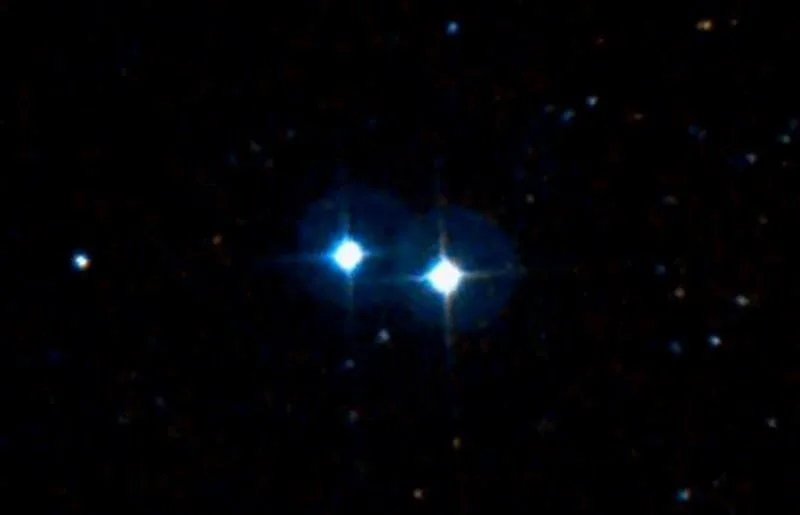
M40 is not a nebula or cluster but a pair of faint stars in Ursa Major, known as Winnecke 4. Charles Messier logged it in 1764 while searching for a nebula that had been reported in this area; he found only the double star and added it to his list anyway. The pair has a combined magnitude of about 9.3 and sits just northeast of the Big Dipper's bowl.
Observing tips
Start at Megrez (Delta Ursae Majoris), where the Big Dipper's handle meets the bowl, and move about 1.4 degrees northeast; the 5th-magnitude star 70 Ursae Majoris lies just southwest of the pair and confirms the field. In binoculars the two stars are hard to separate. A 70 to 100 mm scope at 50x to 75x shows two yellowish stars of similar brightness, roughly 50 arcseconds apart. A 200 mm telescope gives a cleaner view but adds little. It is high overhead in spring from northern latitudes, so even suburban skies are fine.
Because it is faint, use a larger aperture where possible, avoid bright Moon conditions, and use averted vision.
What to expect
Winnecke 4 is an optical double, two unrelated stars that happen to line up from our point of view. Measurements of their distances and motions show that the two stars lie at very different distances, so they are not a gravitationally bound pair.
M40 is tiny, so 1,000 mm or more shows the pair clearly. A wider 300 to 500 mm frame can include Megrez and some of the faint galaxies scattered across this part of Ursa Major.