Observer's guide
About NGC 7092
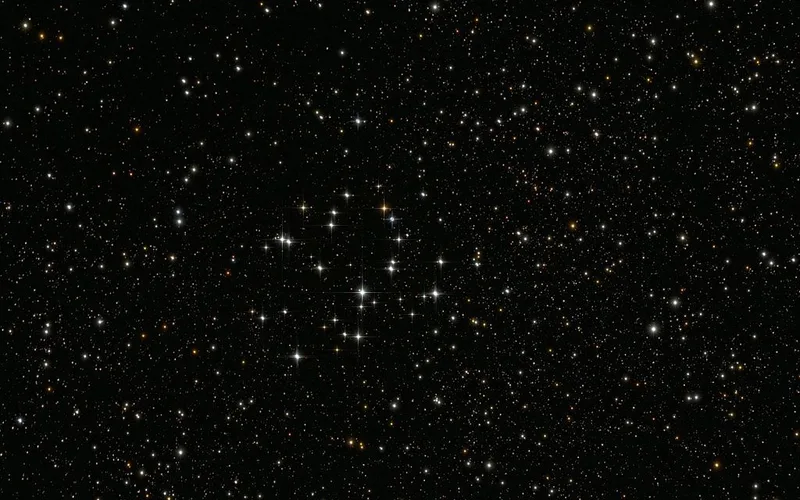
M39 (NGC 7092) is a large, loose open cluster in Cygnus, about 9 degrees east-northeast of Deneb. It is one of the closest Messier clusters at about 825 light-years, shining at magnitude 5.2 across roughly half a degree. Its brightest stars form a rough triangle, and it suits binoculars and wide-field telescopes far better than high-power views.
Observing tips
Start at Deneb and sweep about 9 degrees east-northeast; from a dark site M39 is visible to the naked eye as a hazy spot. In binoculars it resolves into around two dozen stars arranged in a triangle. A 70 to 100 mm scope at 20x to 30x gives the best view, since higher power spreads the stars across the field. A 200 mm telescope shows more faint members but still works best at its lowest power. It passes almost overhead from northern Europe, so altitude is never a problem.
Its brightness makes it a practical binocular or small-telescope candidate when it is well above the horizon.
What to expect
M39 is an open cluster around 300 million years old, made up mostly of white main sequence stars. Its relatively few members are spread over a wide area, and the cluster is gradually losing stars to the gravitational pull of the galaxy.
A focal length of 300 to 500 mm frames M39 with some of the surrounding Cygnus Milky Way. Keep stars small and well colored, as the cluster's appeal lies in its bright, scattered pattern.