Observer's guide
About NGC 1912
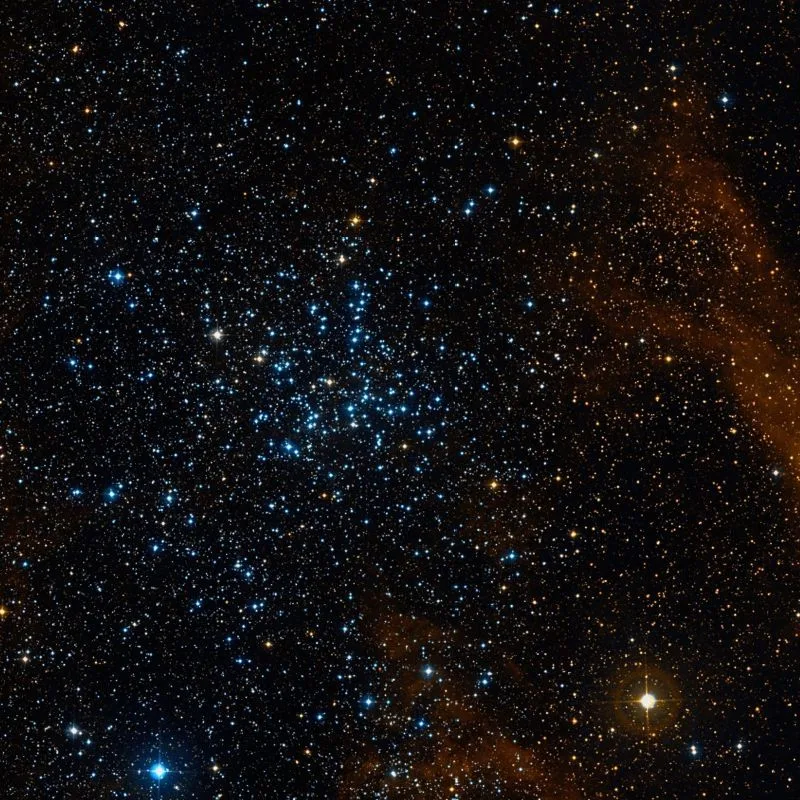
M38 (NGC 1912), the Starfish Cluster, is the most northwesterly of the three Messier clusters in Auriga, about 4,200 light-years away. At magnitude 7.4 it is fainter than M36 and M37, but it is large, at about 20 arcminutes, and shows a distinctive cross or starfish pattern of brighter stars. The small cluster NGC 1907 lies just half a degree south, and the two make a good pair in one field.
Observing tips
Find Iota and Theta Aurigae and look near the midpoint between them; M38 is the soft glow there. In binoculars it shows as a misty patch with a few stars resolved, and M36 appears about 2.3 degrees to the southeast. A 70 to 100 mm scope at 50x shows the cross-shaped pattern of brighter stars and NGC 1907 as a small, faint haze to the south. In a 200 mm telescope, many more faint stars fill in the cluster, and NGC 1907 partly resolves at 100x.
A small telescope under reasonably dark skies is a good starting point; use the live altitude chart to choose its highest point.
What to expect
M38 is an open cluster a few hundred million years old, with a mix of blue-white main sequence stars and some yellow giants. NGC 1907, which appears close by, is a separate and more compact cluster.
Use 500 to 800 mm to frame M38 with NGC 1907, or about 200 mm for all three Auriga clusters together. The open, starfish-like pattern shows best with a modest stretch.