Observer's guide
About NGC 2099
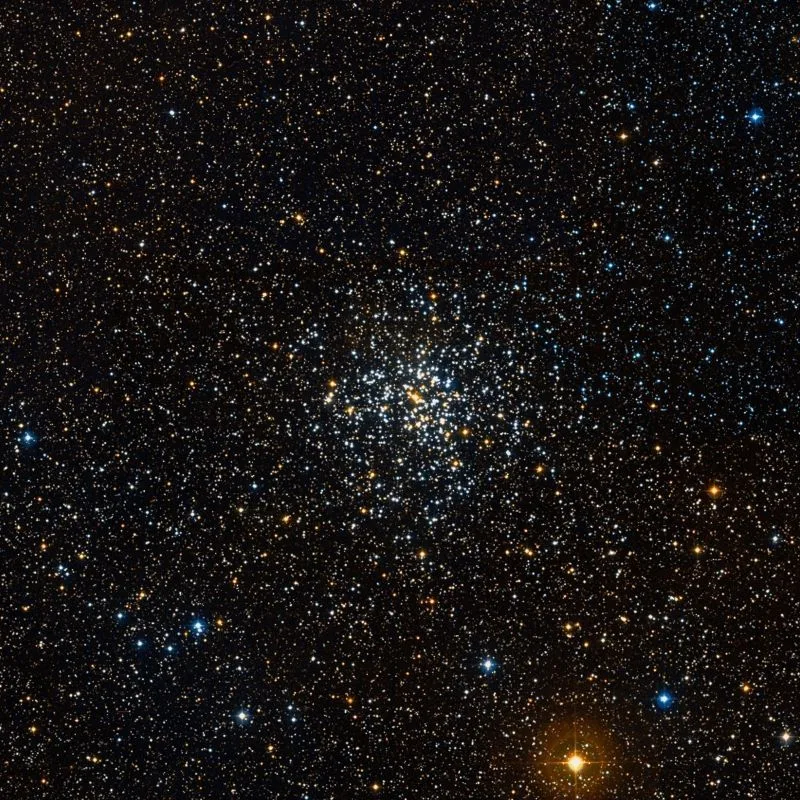
The richest of the three Auriga clusters, M37 (NGC 2099) contains hundreds of stars packed into about 24 arcminutes. It shines at magnitude 6.2 and lies about 4,400 light-years away, just outside the southeastern side of the Auriga pentagon. A conspicuous orange star near its center marks it out in a telescope, and many observers rate it the best open cluster in Auriga.
Observing tips
From M36, move about 3.7 degrees southeast; alternatively, M37 lies about 5 degrees south-southwest of Theta Aurigae. In binoculars it looks like a rich, evenly glowing patch, more condensed than M36 and M38. A 70 to 100 mm scope at 50x to 75x begins to resolve it into many faint stars with a brighter orange star near the middle. With 200 mm at 100x, it becomes a dense field of 100 or more stars broken by dark lanes and chains.
A small telescope under reasonably dark skies is a good starting point; use the live altitude chart to choose its highest point.
What to expect
M37 is an open cluster several hundred million years old, old enough to have produced a number of red giants and white dwarfs. Its large population of faint stars makes it a useful benchmark for testing models of how stars age.
A focal length of 600 to 1,000 mm frames M37 well. Moderate exposures resolve the rich core while showing the color contrast between the orange giant at its center and the white main sequence stars.