Observer's guide
About NGC 1960
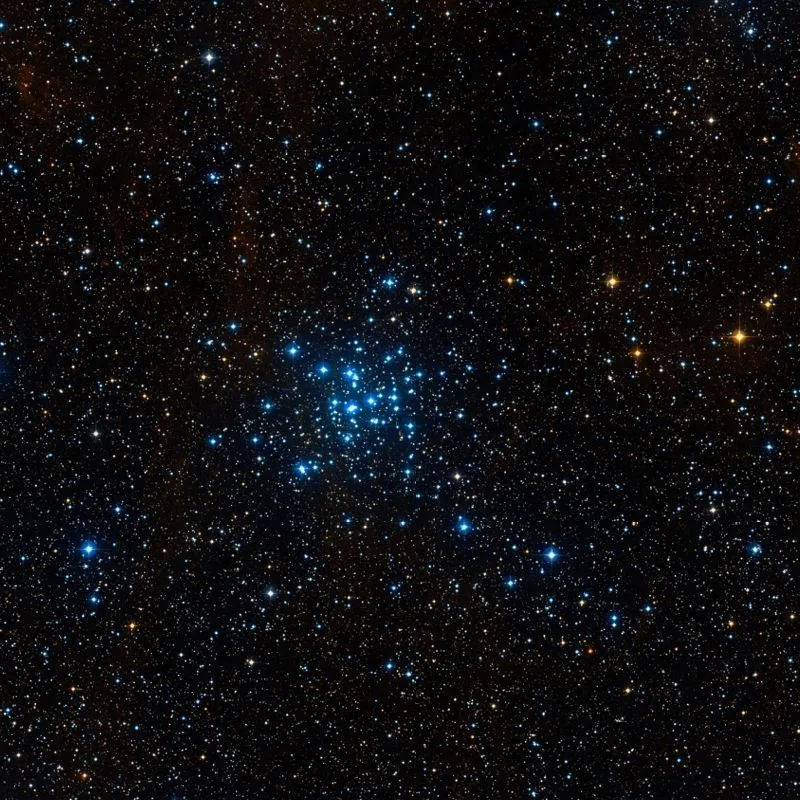
M36 (NGC 1960), sometimes called the Pinwheel Cluster, is the smallest and most compact of the three Messier open clusters in Auriga. It shines at magnitude 6.3, spans about 12 arcminutes and lies around 4,100 light-years away. Its bright stars are fairly evenly spread, with a few dark gaps that give it a pinwheel look, and it sits neatly between its neighbors M37 and M38.
Observing tips
Find M38 near the midpoint of a line from Iota to Theta Aurigae, then move about 2.3 degrees southeast to M36; M37 lies another 3.7 degrees farther southeast. Binoculars show M36 as a small, bright knot that partly resolves. A 70 to 100 mm scope at 50x to 75x shows about two dozen bright stars, several of them in pairs. In a 200 mm telescope it looks crisp and well defined, though less rich than M37.
A small telescope under reasonably dark skies is a good starting point; use the live altitude chart to choose its highest point.
What to expect
M36 is a young cluster, about 25 million years old, dominated by hot blue B-type stars. Comparing it with M37, which is several hundred million years old, shows how a cluster's appearance changes as its brightest stars evolve.
M36 alone suits 800 to 1,000 mm, but a 200 mm lens frames all three Auriga clusters together. Short exposures keep its blue stars tight and well colored.