Observer's guide
About NGC 1039
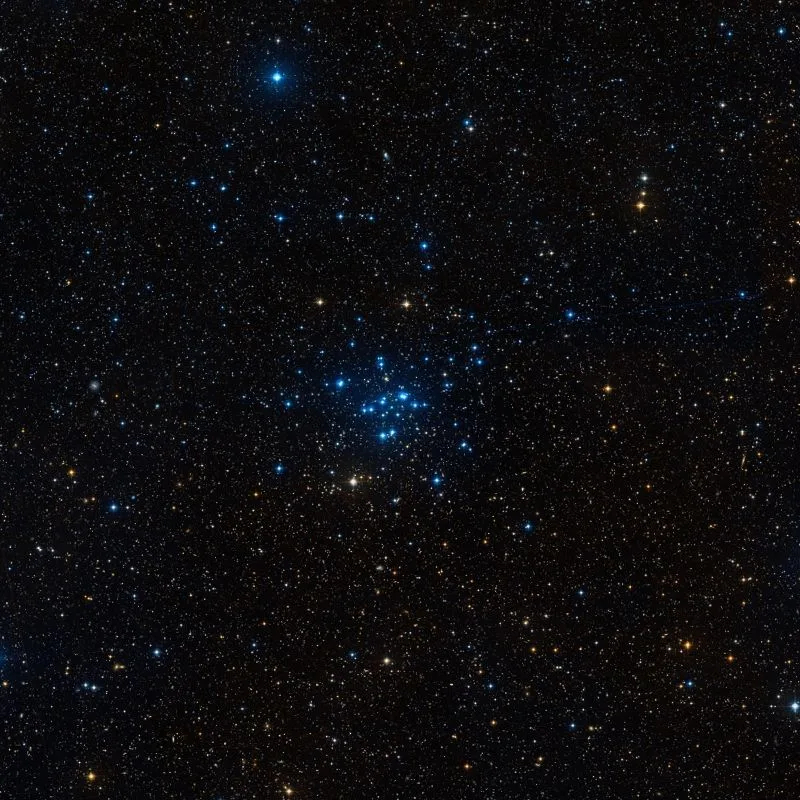
Set between Algol and Almach near the Perseus and Andromeda border, M34 (NGC 1039) is a bright open cluster about 1,400 light-years away. At magnitude 5.5 and around 35 arcminutes across, it is just visible to the naked eye from a dark site and easy in binoculars. Its scattered pattern of bright stars, including several attractive pairs, makes it a good low-power target.
Observing tips
Look roughly midway between Algol (Beta Persei) and Almach (Gamma Andromedae), slightly north of the line joining them. Binoculars show a dozen or more stars over a faint haze. A 70 to 100 mm scope at 30x to 50x resolves the cluster into around 50 stars, including a double star near the center. A 200 mm telescope adds many more faint members but makes the cluster fill the field, so low power still works best. It passes nearly overhead from northern Europe in autumn.
Its brightness makes it a practical binocular or small-telescope candidate when it is well above the horizon.
What to expect
M34 is an open cluster around 200 million years old, with a mix of blue-white and yellow main sequence stars. Because it is nearby and of intermediate age, astronomers use it to study how stars like the Sun slow their spin as they age.
A focal length of 400 to 600 mm frames M34's half-degree spread. Short exposures preserve star colors, and a wider field can include Algol for scale.