Observer's guide
About Triangulum Galaxy
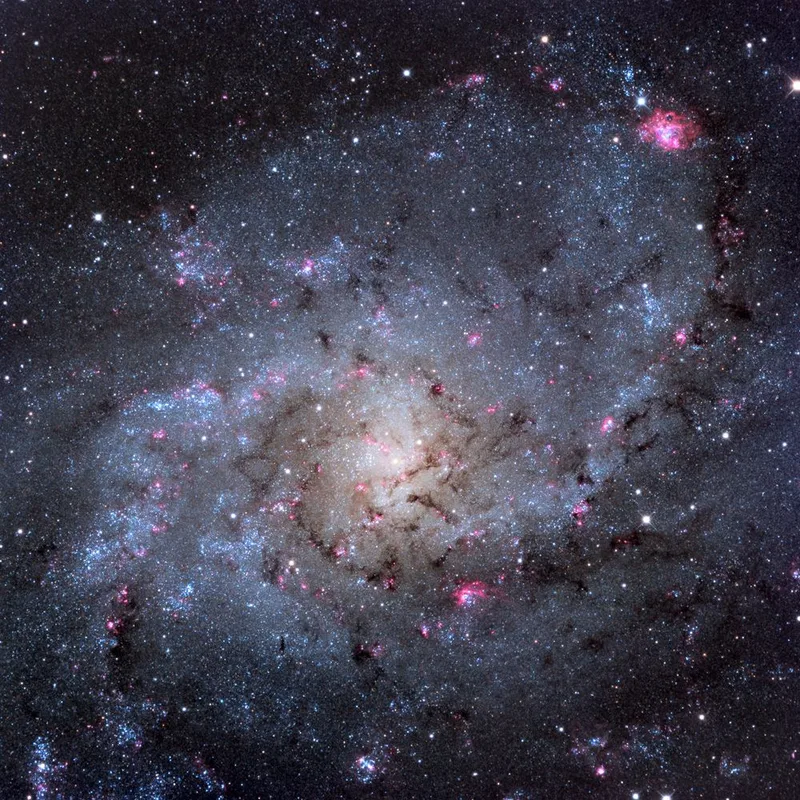
The Triangulum Galaxy, M33 (NGC 598), is the third-largest galaxy in the Local Group after Andromeda and the Milky Way, roughly 3 million light-years away. Despite a total magnitude of 5.7, its light is spread over about 1 by 0.6 degrees, so it can be hard to see under suburban skies. Under a truly dark sky it is a classic test of naked-eye visibility.
Observing tips
From Mirach (Beta Andromedae), go the opposite way from M31, about 7 degrees southeast toward Triangulum; M33 lies about 4 degrees west-northwest of Alpha Trianguli. Binoculars give a large, faint glow and often beat a telescope at high power. A 70 to 100 mm scope at 25x to 40x shows a broad haze with a slightly brighter center. With 200 mm or more under dark skies, the spiral arms start to show, and the star-forming region NGC 604 appears as a distinct knot in the northeast. Use your lowest power and averted vision.
Its brightness makes it a practical binocular or small-telescope candidate when it is well above the horizon.
What to expect
M33 is a late-type spiral of type SA(s)cd, with loose arms and a small central bulge. It is rich in gas and full of active star-forming regions, and NGC 604 is one of the largest known HII regions in the Local Group.
At about one degree across, M33 suits 500 to 800 mm. Long integration and H-alpha data reveal its loose spiral arms and the many red HII regions, including NGC 604.