Observer's guide
About NGC 221
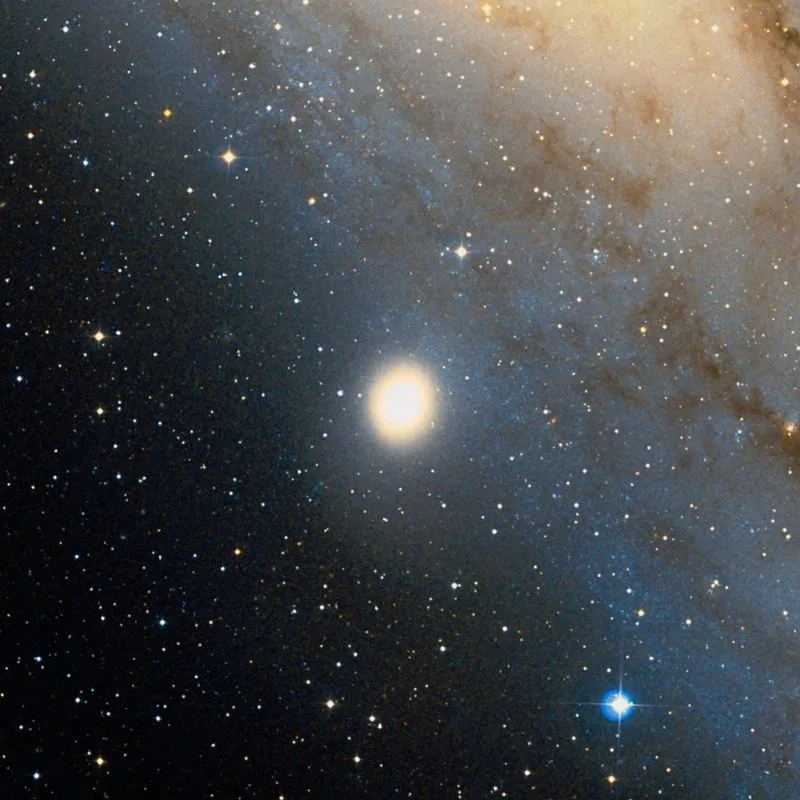
M32 (NGC 221) is a small satellite galaxy of the Andromeda Galaxy, sitting about 24 arcminutes south of M31's nucleus and projected against its outer disk. At magnitude 8.1 it is easy to see, but its small size makes it look like an out-of-focus star at low power. It is the nearest and best-studied example of a compact elliptical galaxy, a rare class of small, very dense ellipticals.
Observing tips
Find M31 using the hop from Mirach through Mu and Nu Andromedae, then look just south of the galaxy's bright core. In binoculars, M32 can be seen as a faint starlike point on the edge of M31's glow. A 70 to 100 mm scope at 50x to 100x shows a small, round, bright disk with a sharp center, clearly not a star. A 200 mm scope at 150x shows a slightly oval shape and a very bright core. It stands up to high power better than M31 itself.
A small telescope under reasonably dark skies is a good starting point; use the live altitude chart to choose its highest point.
What to expect
Compact ellipticals like M32 are thought to be the remains of larger galaxies stripped of their outer stars by a massive neighbor, in this case M31. Its center is extremely dense and hosts a supermassive black hole.
M32 is best captured as part of an M31 image at 400 to 1,000 mm, where it sits on the edge of the disk. For a close view, 1,500 mm or more shows its smooth, bright core; keep exposures short to avoid saturation.