Observer's guide
About Andromeda Galaxy
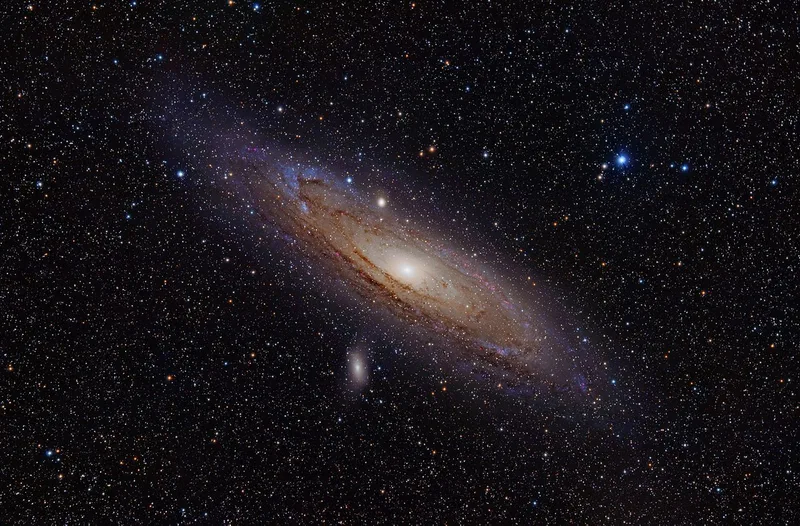
The Andromeda Galaxy, M31 (NGC 224), is the nearest large spiral galaxy to the Milky Way and the most distant object most people can see without optical aid. At magnitude 3.4 it is visible to the naked eye from a dark site as an elongated glow in Andromeda. Its disk spans about 3 by 1 degrees, six times the width of the full Moon, and it is accompanied by the satellite galaxies M32 and M110.
Observing tips
Start at Mirach (Beta Andromedae), hop northwest to Mu Andromedae and continue about the same distance to Nu Andromedae; M31 lies just over a degree west of Nu. Binoculars show the bright core and a long oval glow. A 70 to 100 mm scope at 30x to 40x gives the best overall view and shows M32 as a fuzzy star to the south and M110 to the northwest. With 200 mm or more under dark skies, you can trace a dust lane along the northwest side and the star cloud NGC 206 in the southwest part of the disk. Low power and a wide field matter more than aperture here.
Its brightness makes it a practical binocular or small-telescope candidate when it is well above the horizon.
What to expect
M31 is an SA(s)b spiral similar to, and somewhat larger than, the Milky Way, containing hundreds of billions of stars. It is approaching us at around 300 kilometers per second, and the two galaxies may eventually merge billions of years from now.
To fit the whole galaxy, use about 250 to 500 mm on an APS-C or full-frame camera. Long integration brings out the faint outer disk, and adding H-alpha highlights the red star-forming regions along the spiral arms.