Observer's guide
About NGC 6626
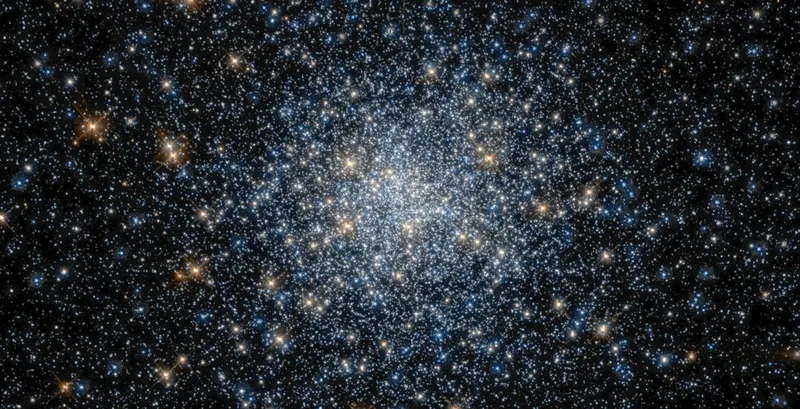
M28 (NGC 6626) is a compact globular cluster in Sagittarius, just above the lid of the Teapot and close to its brighter neighbor M22. It shines at magnitude 6.8, spans about 11 to 15 arcminutes and lies around 17,900 light-years away. In 1987 it became the first globular cluster found to host a millisecond pulsar.
Observing tips
Start at Lambda Sagittarii (Kaus Borealis) and move about 1 degree northwest; M28 is a small, condensed glow, with M22 about 3 degrees to the east. In binoculars it looks like a fuzzy star. A 70 to 100 mm scope shows a bright core with an even halo and little resolution. A 200 mm telescope at 150x to 200x resolves the outer halo into faint stars. From northern latitudes it transits low, about 13 degrees up from 52 degrees north, so pick a steady, transparent night.
A small telescope under reasonably dark skies is a good starting point; use the live altitude chart to choose its highest point.
What to expect
Millisecond pulsars are neutron stars spun up to very high rates by pulling material from a companion star, a process that happens more often in the crowded cores of globular clusters. Apart from its pulsars, M28 is a typical old globular of the inner Milky Way.
A focal length of 1,000 to 1,500 mm frames M28 nicely, and a 300 mm lens can pair it with M22 in one frame. Image near the meridian, since low altitude softens stars.