Observer's guide
About Dumbbell Nebula
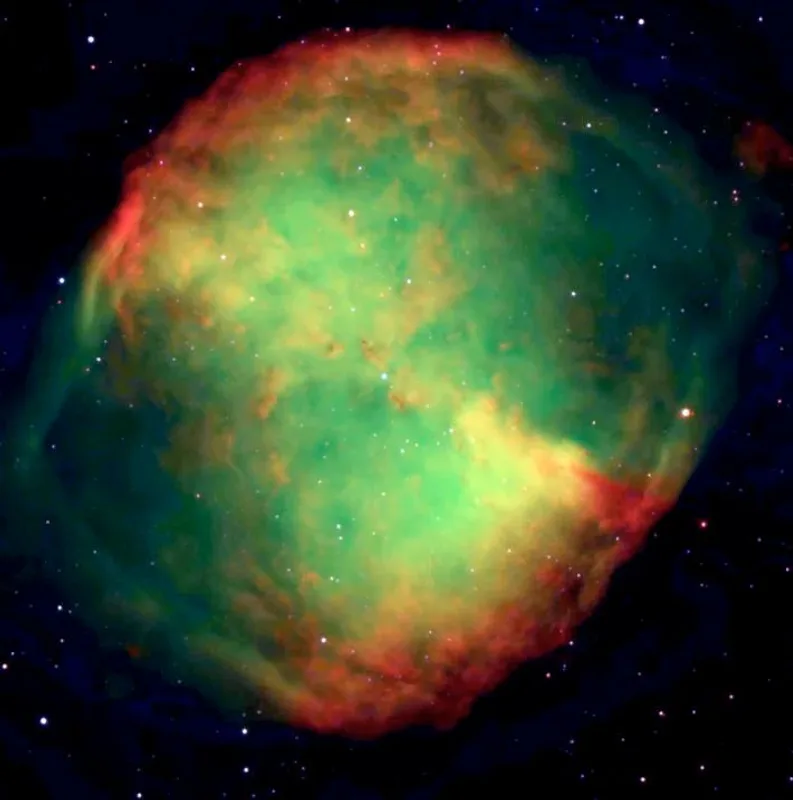
The Dumbbell Nebula, M27 (NGC 6853), was the first planetary nebula ever discovered, found by Charles Messier in 1764. It lies in the small constellation Vulpecula, about 1,250 light-years away, and at magnitude 7.4 it is one of the brightest and largest planetaries in the sky, covering about 8 by 6 arcminutes. Its shape, two bright lobes joined at the center, gives it the names Dumbbell and Apple Core.
Observing tips
From Gamma Sagittae, the star at the tip of the arrow in Sagitta, move about 3 degrees north; M27 shows as a small gray patch even in binoculars. A 70 to 100 mm scope at 50x to 80x shows the bowtie or apple-core shape clearly. With 200 mm and an OIII or UHC filter, the fainter outer areas fill in and make the nebula oval, and the 13th-magnitude central star becomes visible at higher power. It rides high in summer from mid-northern latitudes, so seeing is the main limit.
A small telescope under reasonably dark skies is a good starting point; use the live altitude chart to choose its highest point.
What to expect
A planetary nebula forms when a sunlike star runs out of fuel in its core and sheds its outer layers. The hot exposed core, on its way to becoming a white dwarf, emits ultraviolet light that makes the expanding gas glow. Over tens of thousands of years the shell will thin out and fade.
At about 8 arcminutes, M27 fits well at 800 to 1,500 mm. H-alpha and OIII narrowband data bring out the faint outer halo and the red and teal colors of the inner lobes.