Observer's guide
About IC 4725
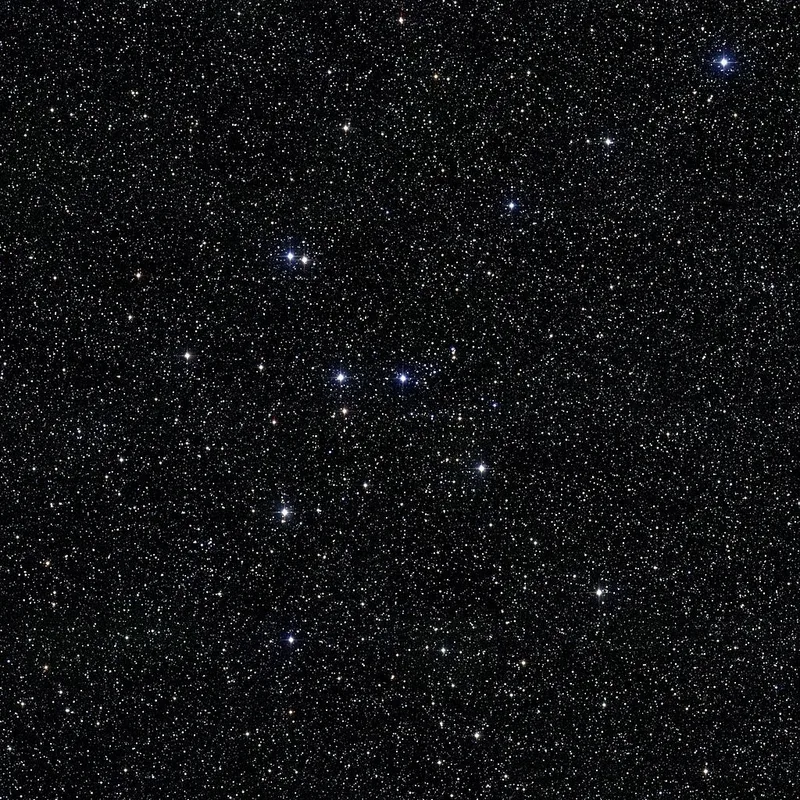
Unusually for a Messier object, M25 carries an Index Catalogue number, IC 4725, rather than an NGC number. It is a bright, scattered open cluster in Sagittarius, magnitude 6.5 and about 30 arcminutes across, visible to the naked eye from dark sites and about 2,000 light-years away. It contains the Cepheid variable U Sagittarii, which changes brightness on a cycle of just under 7 days.
Observing tips
Find M24 and move about 3.5 degrees east; M25 appears in binoculars as a loose group of stars of mixed brightness. A 70 to 100 mm scope at 30x to 50x shows several dozen stars, including a few orange ones. A 200 mm telescope adds many faint members but can make the cluster look less distinct, so stay at low power. Compare U Sagittarii with nearby stars over several nights and you can follow its brightness changes yourself.
A small telescope under reasonably dark skies is a good starting point; use the live altitude chart to choose its highest point.
What to expect
Among M25's members are the Cepheid U Sagittarii and a few yellow and orange giants. Cepheids in clusters are valuable because the cluster's distance can be measured independently, which helps calibrate the period-luminosity relation used to find distances to other galaxies.
At about 30 arcminutes, M25 frames well at 500 to 800 mm. Keep the stretch gentle to retain star colors, especially the orange giants among its bluer members.