Observer's guide
About Sagittarius Star Cloud
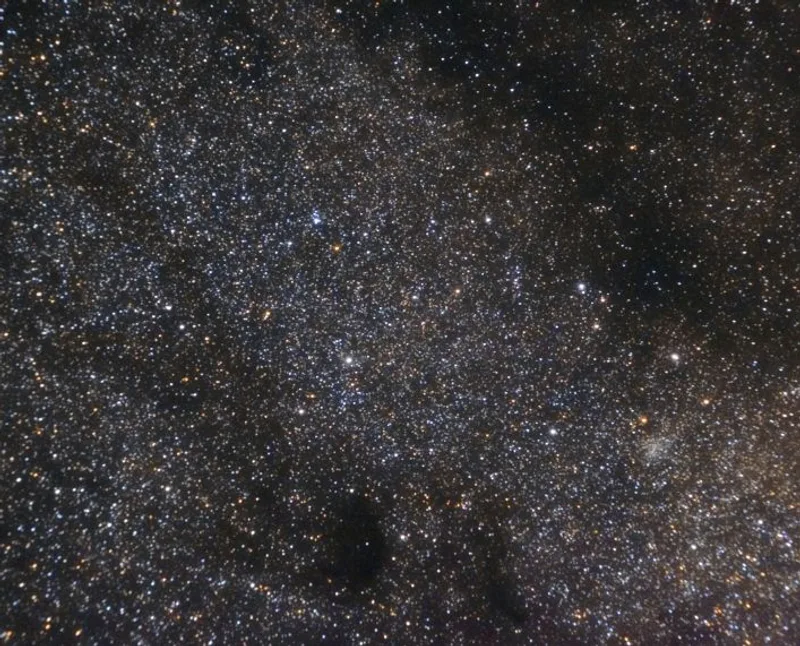
The Sagittarius Star Cloud, M24, is not a true cluster but a window through the dust of the Milky Way, where we look out across a dense stretch of distant stars. Also called the Small Sagittarius Star Cloud, it is roughly 2 degrees long and shines at magnitude 4.6, easily visible to the naked eye from a dark site. The small open cluster NGC 6603 lies within it, and its NGC number is sometimes attached to the whole cloud.
Observing tips
M24 lies about 2.5 degrees south-southwest of M17, north of the Teapot's lid, and is obvious to the naked eye as a bright patch of Milky Way. Binoculars are the best instrument for it, showing a grainy carpet of stars with sharp, dark edges. A 70 to 100 mm scope at low power lets you scan the star fields and pick out NGC 6603, a small, rich knot within the cloud, plus the dark nebulae Barnard 92 and 93 on the northwest side. In a 200 mm telescope the star density becomes overwhelming, so use your widest field.
Its brightness makes it a practical binocular or small-telescope candidate when it is well above the horizon.
What to expect
The stars of M24 lie in an inner spiral arm of the Milky Way about 10,000 light-years away, seen through a gap in the foreground dust. Light from a vast number of stars crowds into this one patch of sky, which is why it looks so bright.
A focal length of 135 to 300 mm frames the full cloud with M17, M18 and the dark nebulae on its edge. Shoot in broadband color to bring out the range of star colors and the dusty boundaries.