Observer's guide
About NGC 6494
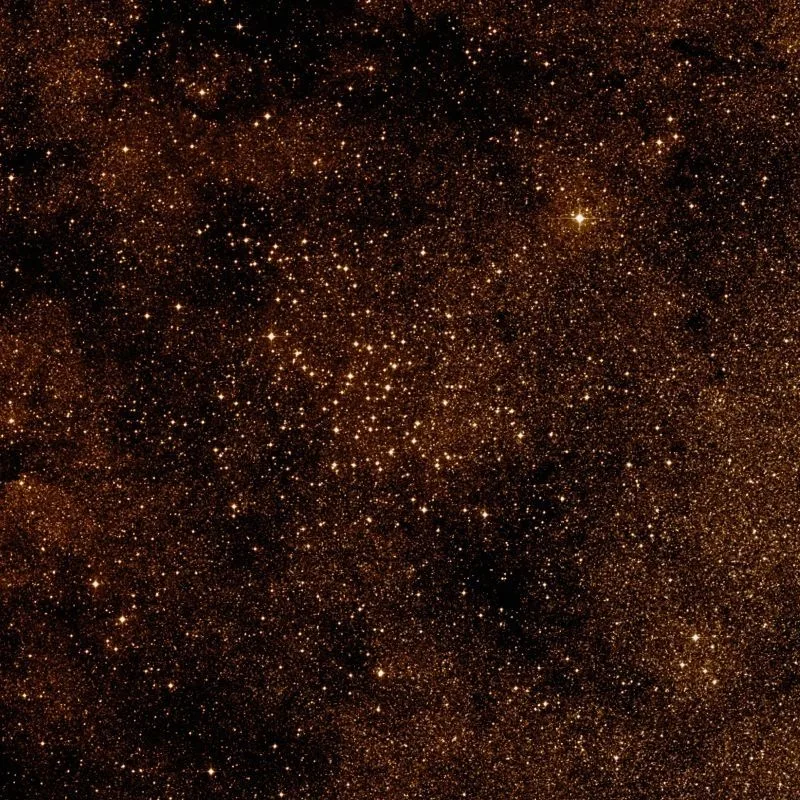
West of the Sagittarius Star Cloud, M23 (NGC 6494) is a large, rich open cluster about 2,150 light-years away. At magnitude 6.9 it spreads its stars over about 25 to 35 arcminutes, roughly the size of the full Moon. Observers often skip it in favor of the nebulae nearby, but it is one of the better open clusters in this part of the Milky Way.
Observing tips
From Mu Sagittarii, move about 4.5 degrees west-northwest; a binocular sweep there shows a rich, grainy patch that partly resolves into a scatter of faint stars. A 70 to 100 mm scope at 40x to 60x shows dozens of stars arranged in curving chains. A 200 mm telescope reveals a hundred or more stars, but use a wide-field eyepiece to keep the whole cluster in view. From 52 degrees north it reaches about 19 degrees, so choose a night with a clear southern horizon.
A small telescope under reasonably dark skies is a good starting point; use the live altitude chart to choose its highest point.
What to expect
M23 is an open cluster around 300 million years old. By that age, the most massive stars it was born with have already evolved and died, leaving mostly white and yellow main sequence stars that still travel together through the galactic disk.
At around 30 arcminutes, M23 fits well at 500 to 800 mm. A clean, moderately stretched image with tight stars shows the curving chains best.