Observer's guide
About NGC 6656
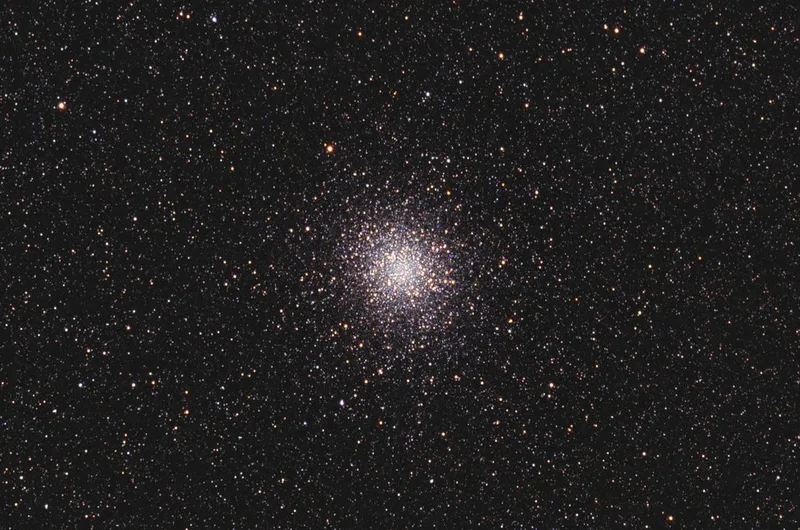
M22 (NGC 6656), the Great Sagittarius Cluster, is one of the brightest globular clusters in the sky at magnitude 5.1, outshone only by Omega Centauri and 47 Tucanae. At around 10,100 light-years it is also one of the nearest. It lies just above the lid of the Teapot asterism, and it was one of the first globular clusters ever recorded, noted in 1665.
Observing tips
Start at Lambda Sagittarii (Kaus Borealis), the star at the top of the Teapot's lid, and move about 2.5 degrees northeast. Binoculars show a large, bright, round glow, and from dark southern sites it is visible to the naked eye. A 70 to 100 mm scope at 75x to 100x resolves many of its brighter stars. With 200 mm at 150x, it resolves across its face and shows a slightly oval outline. From 52 degrees north it rises only about 14 degrees, but it is still worth hunting, since few globulars resolve this easily.
Its brightness makes it a practical binocular or small-telescope candidate when it is well above the horizon.
What to expect
M22 is an old globular cluster lying in front of the galactic bulge. It is one of only a few globulars known to contain a planetary nebula, and radio observations have revealed two candidate stellar-mass black holes inside it.
With a halo around 24 arcminutes across, M22 suits 600 to 1,000 mm. Its stars are well separated, so moderate exposures show resolution to the core, and southern sites give much sharper results.