Observer's guide
About Trifid Nebula
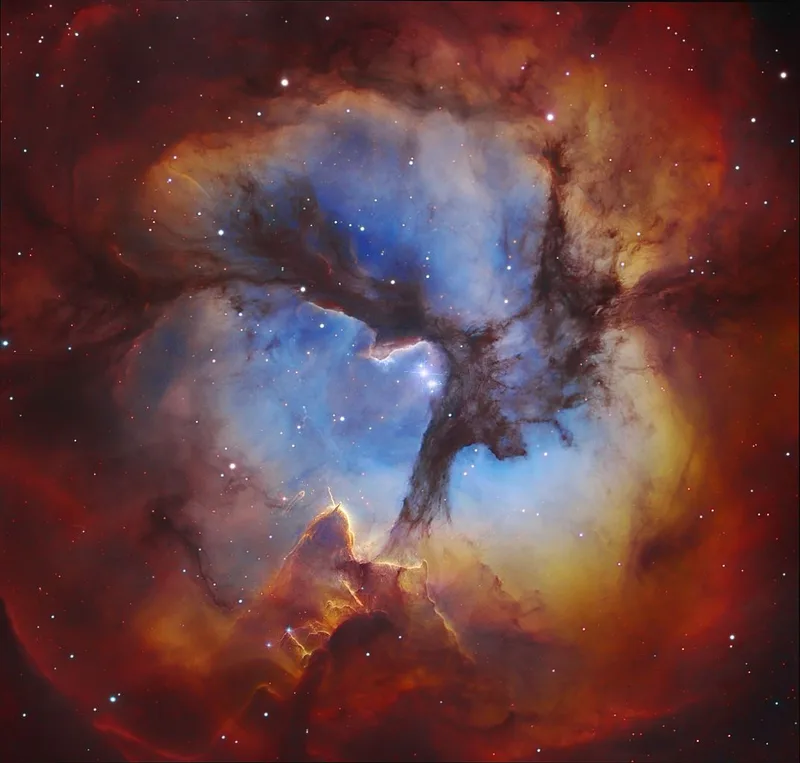
The Trifid Nebula, M20 (NGC 6514), combines three kinds of nebula in one view: a red emission region, a blue reflection nebula, and dark dust lanes that split the bright part into three lobes. It lies in Sagittarius about 5,200 light-years away, just over a degree north of the Lagoon Nebula. With a combined brightness near magnitude 9 spread over almost half a degree, it needs darker skies than its famous neighbor.
Observing tips
Find M8 and move about 1.5 degrees north; in binoculars M20 shows as a small hazy patch around the multiple star at its center. In a 70 to 100 mm scope at 50x to 80x you can see a faint round glow, and with a UHC filter the dark lanes start to show as darker gaps. A 200 mm telescope with a UHC filter reveals the three-lobed shape, while the blue reflection nebula to the north does not respond to filters and is best viewed without one. Dark, transparent skies are essential, and northern observers need the object near the meridian.
Because it is faint, use a larger aperture where possible, avoid bright Moon conditions, and use averted vision.
What to expect
M20 is a young star-forming region. The emission part glows because the massive star at its center ionizes the surrounding hydrogen, while the blue lobe to the north is dust reflecting starlight. The dark lanes are dust clouds that block the light behind them.
A focal length of 600 to 1,000 mm frames the Trifid with its blue reflection lobe, or 300 to 400 mm includes M8 as well. Use broadband color data to capture the blue reflection nebula, since narrowband filters miss it.