Observer's guide
About Crab Nebula
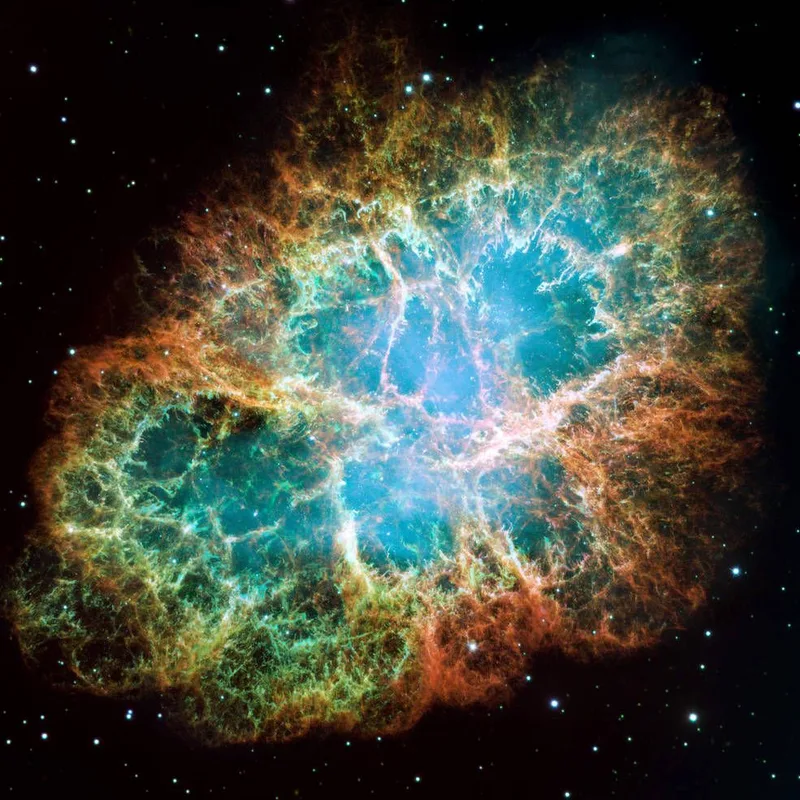
Messier 1, the Crab Nebula (NGC 1952, also the radio source Taurus A), is the expanding wreck of a star whose explosion was recorded by Chinese astronomers in 1054. It lies in Taurus, just off the southern horn of the bull, and shines at magnitude 8.4 across roughly 6 by 4 arcminutes. Charles Messier came across it in 1758 while hunting a comet, and it became the first entry in his list.
Observing tips
Start at Zeta Tauri, the star marking the tip of the bull's southern horn, and move about 1 degree northwest; M1 sits there with no bright stars around it. Binoculars show only a faint smudge under dark skies. A 70 to 100 mm scope at 50x to 80x shows an oval gray glow, slightly brighter toward the middle. In a 200 mm or larger instrument at 150x and above, the edges look ragged, and with averted vision you can pick up hints of the filaments. A UHC or OIII filter adds a little contrast, though the Crab responds less to filters than most emission nebulae.
A small telescope under reasonably dark skies is a good starting point; use the live altitude chart to choose its highest point.
What to expect
The Crab is a supernova remnant powered by a pulsar at its center, a neutron star that spins about 30 times per second. Energy from the pulsar lights the inner nebula with synchrotron radiation, while the outer filaments of hydrogen and heavier elements are still expanding from the 1054 explosion. It lies about 6,300 light-years away.
At about 7 by 5 arcminutes, M1 suits focal lengths of 1,000 mm or more. Combine broadband color for the bluish synchrotron core with H-alpha and OIII data to bring out the red and teal filament network.