Observer's guide
About NGC 6273
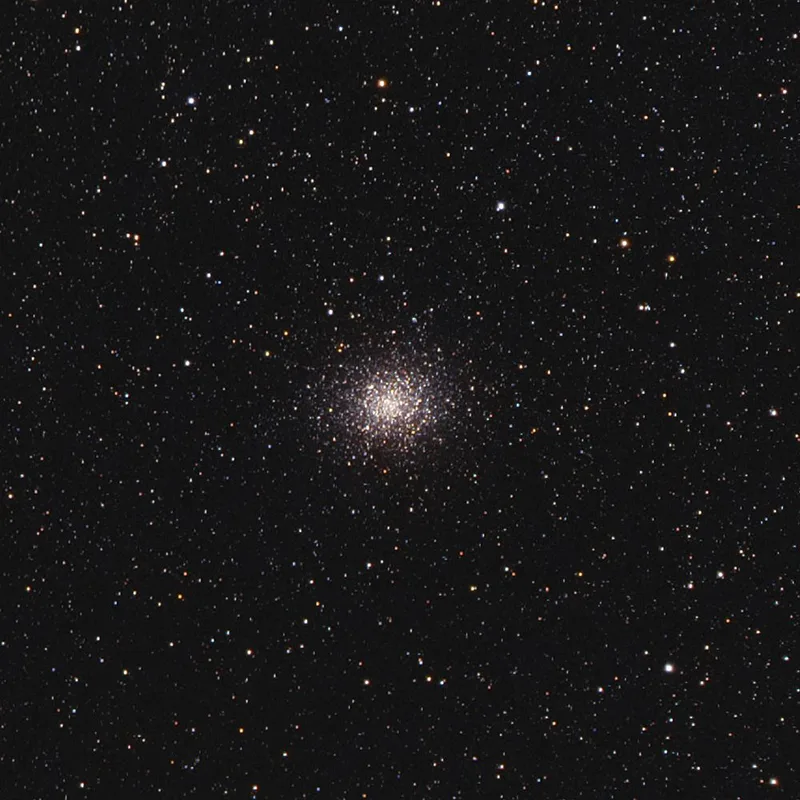
M19 (NGC 6273) is a globular cluster in southern Ophiuchus, close to the border with Scorpius and about 27,100 light-years away. At magnitude 6.8 it is reasonably bright, and it is one of the most flattened globular clusters known, appearing noticeably oval in a telescope. In space it lies relatively close to the center of the galaxy, in one of the most crowded parts of the sky.
Observing tips
From Antares, move about 7.5 degrees east at nearly the same declination. In binoculars M19 is a small, fuzzy star. A 70 to 100 mm scope at 100x shows an oval glow, elongated roughly north to south, with a bright center. A 200 mm telescope at 150x to 200x starts to resolve the edges into faint stars. From 52 degrees north it rises only about 12 degrees, so wait for it to cross the meridian and use averted vision.
A small telescope under reasonably dark skies is a good starting point; use the live altitude chart to choose its highest point.
What to expect
M19 is an old, massive globular cluster with an unusually oblate outline for its class. Thick dust toward the galactic center dims its light by around a magnitude, so it would appear noticeably brighter without that foreground material.
At around 10 arcminutes, M19 works at 1,000 to 1,500 mm. From high northern latitudes, image it near the meridian and keep subexposures short to limit the effect of turbulent air near the horizon.