Observer's guide
About NGC 6613
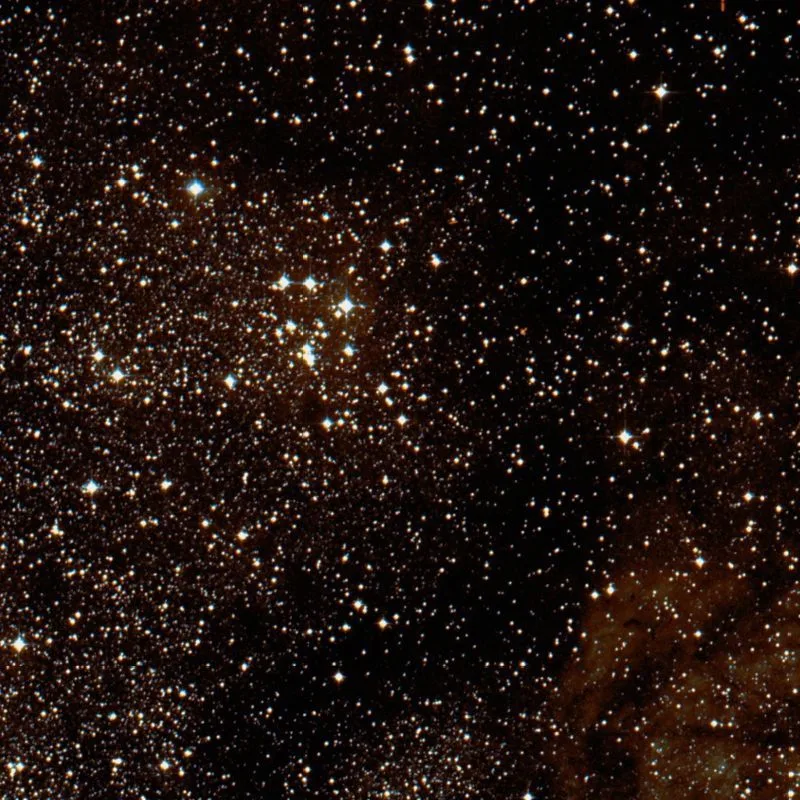
Between the bright nebula M17 and the Sagittarius Star Cloud lies M18 (NGC 6613), a small open cluster that is easy to overlook. It shines at magnitude 7.5, covers about 9 arcminutes and lies roughly 4,900 light-years away. It is one of the plainer objects in the Messier catalog, but its rich surroundings make the area worth a slow sweep.
Observing tips
Find M17 and move about 1 degree south; M18 is a compact knot of stars in a rich Milky Way field. In binoculars it looks like a small, granular patch. A 70 to 100 mm scope at 50x to 80x shows about a dozen stars in a loose grouping, some in a short chain. A 200 mm telescope adds fainter members but does not change its sparse character. Low power works best, because it lets you see M18 against the surrounding star fields with M17 in the same view.
A small telescope under reasonably dark skies is a good starting point; use the live altitude chart to choose its highest point.
What to expect
M18 is a young open cluster, probably a few tens of millions of years old, made up mostly of hot blue stars. Like most open clusters, it will slowly disperse into the galactic disk over the next few hundred million years.
Use 400 to 600 mm to frame M18 together with M17 and the edge of the star cloud, which is more rewarding than a close crop. Moderate exposures preserve star color in the dense field.