Observer's guide
About Omega Nebula
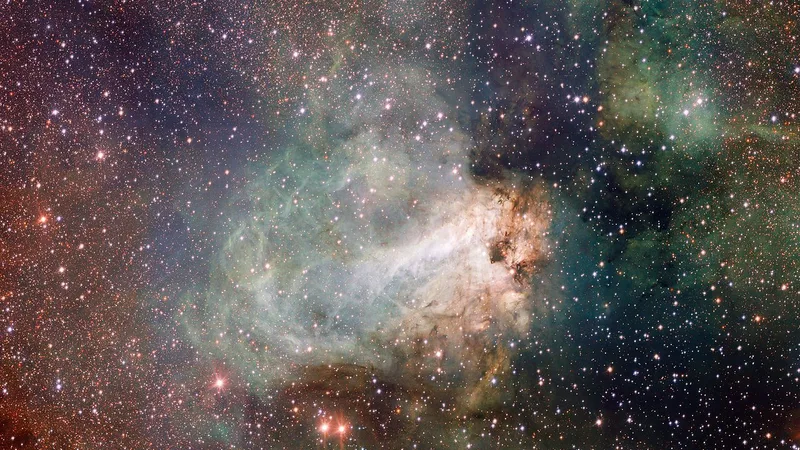
The Omega Nebula, M17 (NGC 6618), also called the Swan or Horseshoe Nebula, is one of the brightest star-forming regions in the summer Milky Way. It lies in northern Sagittarius near the Scutum border, about 5,000 light-years away, and shines at magnitude 7. Its bright bar with a curled hook at one end is easy to see even in small telescopes, which is how it picked up so many names.
Observing tips
From Gamma Scuti, move about 2.5 degrees southwest, or find M24 and go about 2.5 degrees north-northeast. In binoculars it shows as a short, bright streak. A 70 to 100 mm scope at 40x to 60x clearly shows the bar and hook, the swan's body and neck. With a 200 mm telescope and a UHC or OIII filter, the nebula extends into faint wings and shows dark patches along the bar. It peaks at about 22 degrees from 52 degrees north, so it is best caught on the meridian.
A small telescope under reasonably dark skies is a good starting point; use the live altitude chart to choose its highest point.
What to expect
M17 is a massive HII region ionized by a cluster of hot young stars, many of them hidden by the surrounding dust. It is one of the most active star-forming regions in our part of the galaxy, and the glowing gas we see is only part of a much larger molecular cloud.
A focal length of 600 to 1,200 mm frames the bright swan shape with room for the fainter outer gas. H-alpha captures most of the structure, and adding OIII helps show the blue-green inner region.