Observer's guide
About Eagle Nebula
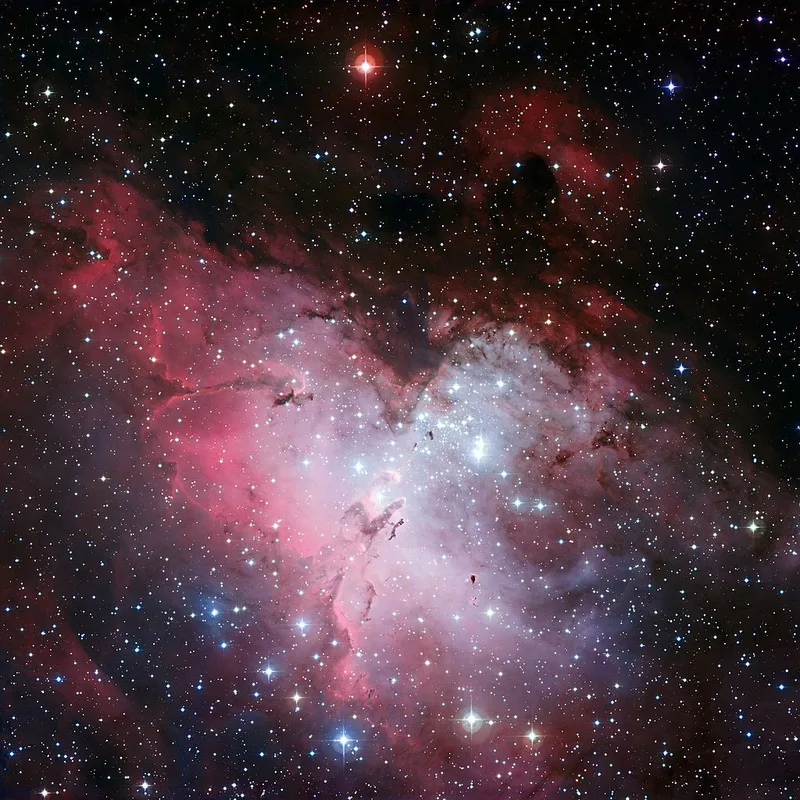
The Eagle Nebula, M16 (NGC 6611), combines a young open cluster with the emission nebula around it, in Serpens Cauda near the Sagittarius border. The cluster shines at magnitude 6.4, and the glowing gas spreads well beyond its 25 arcminute core, about 7,000 light-years away. Hubble's 1995 image of the dust columns inside it, the Pillars of Creation, made it one of the best-known nebulae in the sky. It is also called the Star Queen Nebula.
Observing tips
Locate M17 first and move about 2.5 degrees north; on dark nights M16 shares a binocular field with the Omega Nebula. Binoculars and small scopes show mostly the cluster, a group of a dozen or so stars in a faint haze. A 70 to 100 mm scope with a UHC filter brings out the nebula around the stars. In a 200 mm telescope with a UHC or OIII filter, the dark notch where the pillars sit becomes visible on good nights, though the pillars themselves are hard to see directly. From 52 degrees north it peaks at about 24 degrees.
A small telescope under reasonably dark skies is a good starting point; use the live altitude chart to choose its highest point.
What to expect
M16 is a star-forming region where hot, massive stars of the cluster NGC 6611, only a few million years old, ionize the surrounding hydrogen. Their radiation is slowly eroding the dense dust columns, while new stars are still forming inside the pillars themselves.
A focal length of 600 to 1,000 mm frames the full nebula, while 1,500 mm or more isolates the pillars. Narrowband H-alpha, OIII and SII data work well here, as in the familiar Hubble palette.