Observer's guide
About NGC 6402
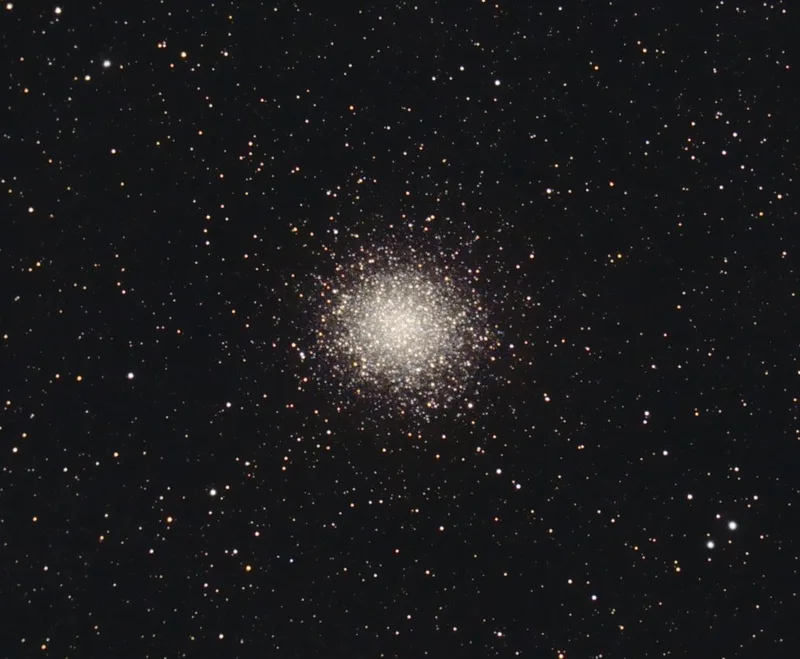
M14 (NGC 6402) is a rather overlooked globular cluster in Ophiuchus, about 27,400 light-years away. At magnitude 7.6 and with a fairly even, loosely concentrated structure, it looks fainter than M10 and M12 but turns out large and rich in bigger telescopes. It sits in a sparse area well away from the brighter stars of the constellation, which is one reason it is often skipped.
Observing tips
M14 lies about 10 degrees east of M10 at almost the same declination, or about 6.5 degrees south-southwest of Gamma Ophiuchi. In binoculars it is a faint round smudge. A 70 to 100 mm scope shows an even glow with little central brightening and few or no resolved stars. In a 200 mm telescope at 150x to 200x, the surface becomes granular and many faint stars emerge, though the cluster never fully resolves. Use averted vision and the darkest sky you can reach.
A small telescope under reasonably dark skies is a good starting point; use the live altitude chart to choose its highest point.
What to expect
M14 is a large, massive globular whose stars are spread fairly evenly rather than packed into a tight core. A nova that erupted in the cluster in 1938 was captured on photographic plates but only noticed decades later.
A focal length of 1,000 to 1,500 mm fills a typical sensor with M14's 7 to 13 arcminute disk. Long total integration helps, because its stars are fainter than those of the other Ophiuchus globulars.