Observer's guide
About Hercules Globular Cluster
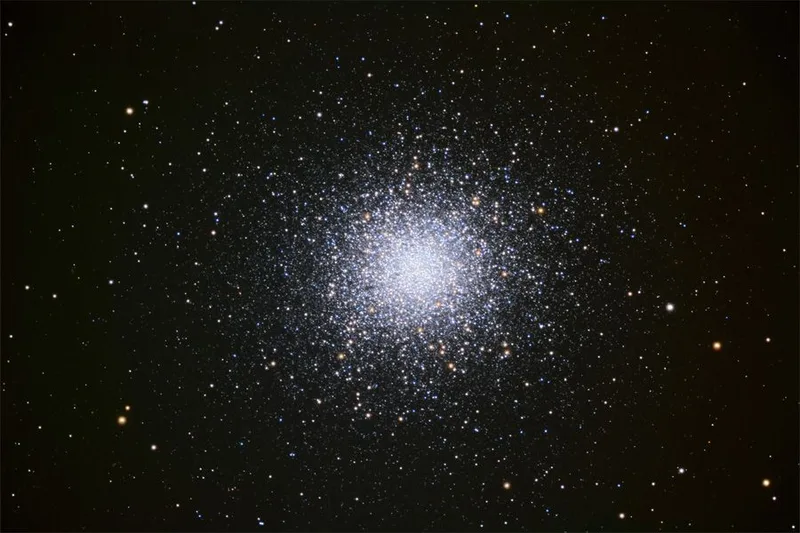
Known as the Great Globular Cluster in Hercules, M13 (NGC 6205) is the brightest globular cluster easily seen from mid-northern latitudes. It lies about 22,800 light-years away, shines at magnitude 5.8 and spans more than 20 arcminutes. Edmond Halley spotted it in 1714, and in 1974 the Arecibo radio telescope beamed a message toward it.
Observing tips
Find the Keystone, the four-star quadrilateral at the center of Hercules, and look along its western side between Eta and Zeta Herculis, about a third of the way from Eta. Binoculars show a round glow, and from a dark site it is just visible to the naked eye. A 70 to 100 mm scope at 100x resolves the edges into a fine grain of stars. With 200 mm or more at 150x to 250x, the cluster resolves to the core, and you can look for the three dark lanes known as the Propeller. The galaxy NGC 6207 lies about half a degree to the northeast.
Its brightness makes it a practical binocular or small-telescope candidate when it is well above the horizon.
What to expect
M13 contains several hundred thousand stars bound in a dense sphere, most of them old red and yellow stars formed early in the galaxy's history. It also contains blue stragglers, stars that look younger than the rest and are thought to form when stars merge or exchange mass.
With a halo over 20 arcminutes across, M13 suits 800 to 1,500 mm, and a slightly wider frame includes NGC 6207. Shoot many short subexposures to keep core stars separated and to show the faint outer halo.