Observer's guide
About NGC 205
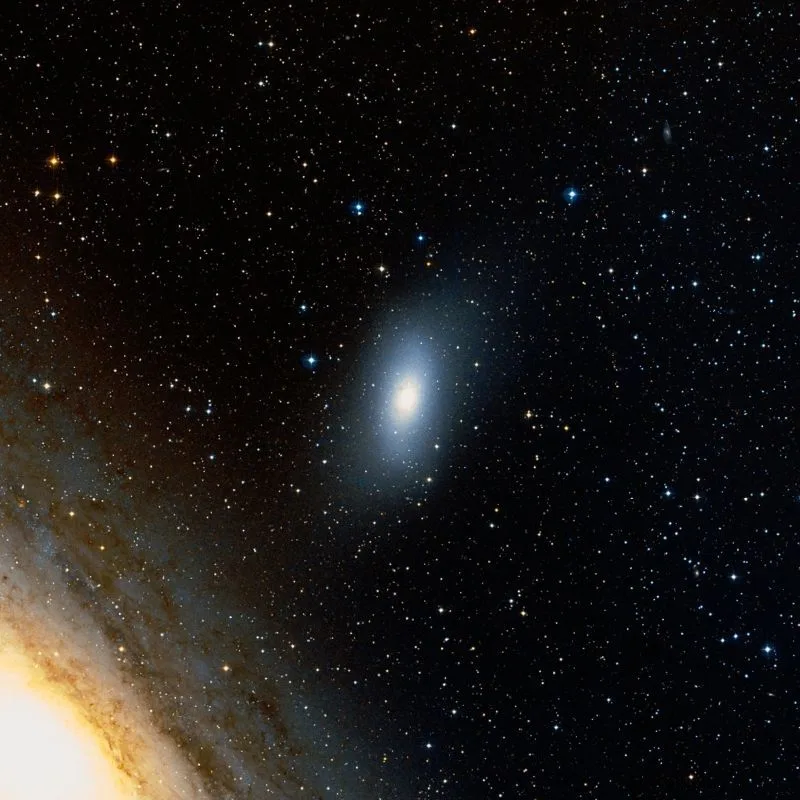
Of the two bright satellite galaxies of the Andromeda Galaxy, M110 (NGC 205) is the larger and more diffuse. This dwarf elliptical lies in Andromeda about 2.5 million light-years away and shines at magnitude 8.5. Its low surface brightness makes it harder to see than its compact companion M32, but it shows well in a wide field next to M31.
Observing tips
Find M31 by moving from Mirach (Beta Andromedae) through Mu Andromedae and continuing about the same distance again; M110 lies about 35 arcminutes northwest of the core of M31. Binoculars may show it as a faint, oval patch under dark skies. A 70 to 100 mm telescope at 40x reveals a dim, elongated glow with little central brightening. In a 200 mm scope, the oval becomes clearer and slightly brighter toward the center. Use low power and a wide field to keep both M31 and M110 in view.
A small telescope under reasonably dark skies is a good starting point; use the live altitude chart to choose its highest point.
What to expect
M110 is a dwarf elliptical galaxy orbiting M31, made mostly of old stars. Unusually for its type, it contains dust patches and a few young blue stars, a sign of fairly recent star formation, possibly triggered by its interaction with M31.
M110 is usually captured with M31 and M32 at 300 to 500 mm. For a closer view, 1000 mm and long integration help show its dust patches and smooth halo.