Observer's guide
About NGC 3992
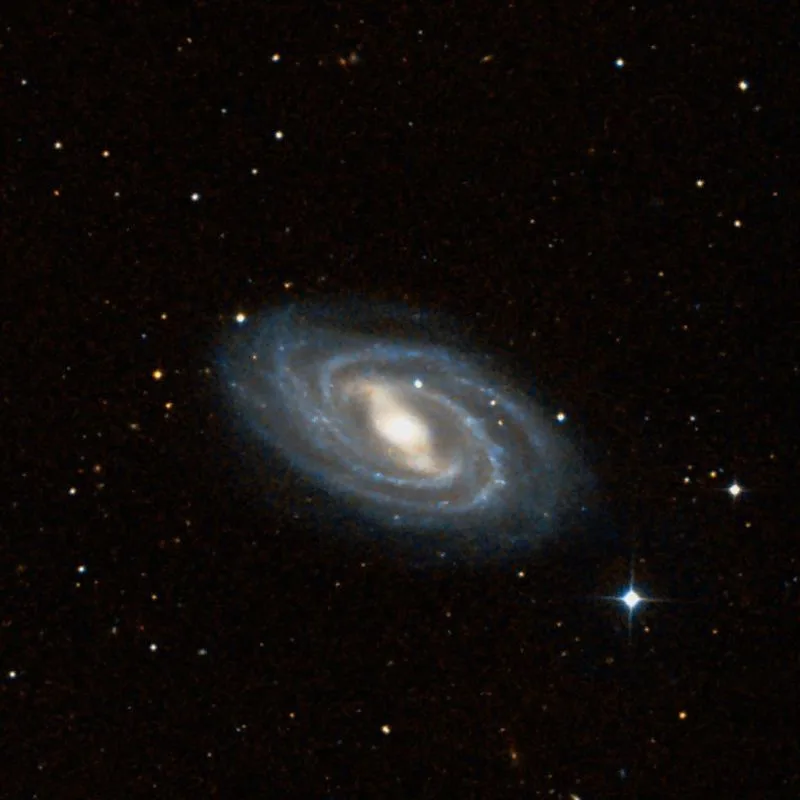
Less than a degree from Phecda, the star at the southeastern corner of the Big Dipper's bowl, lies M109 (NGC 3992), a barred spiral of magnitude 9.8. It is about 55 million light-years away and is the brightest member of a group of galaxies in Ursa Major. Its central bar and inner ring give it a shape like the Greek letter theta in long-exposure images.
Observing tips
Find Phecda (Gamma Ursae Majoris) and move about 40 arcminutes southeast; M109 lies just off the star. Binoculars show nothing. A 70 to 100 mm telescope at 60x reveals a faint, oval glow with a brighter center, partly washed out by the glare of Phecda. With 200 mm at 100x to 150x, the bar becomes visible as a brighter, elongated core. Higher power and keeping Phecda just outside the field both help reduce the glare.
Because it is faint, use a larger aperture where possible, avoid bright Moon conditions, and use averted vision.
What to expect
M109 is a barred spiral with a bright central bar and a ring connecting the arms. It is the dominant galaxy of a group in Ursa Major with several small companions nearby, and it hosted the Type Ia supernova SN 1956A.
At about 7.6 by 4.9 arcminutes, M109 suits 1000 to 1500 mm. Keep Phecda just outside the frame or use careful processing to control its glare, and use long integration to bring out the faint outer arms.