Observer's guide
About NGC 6171
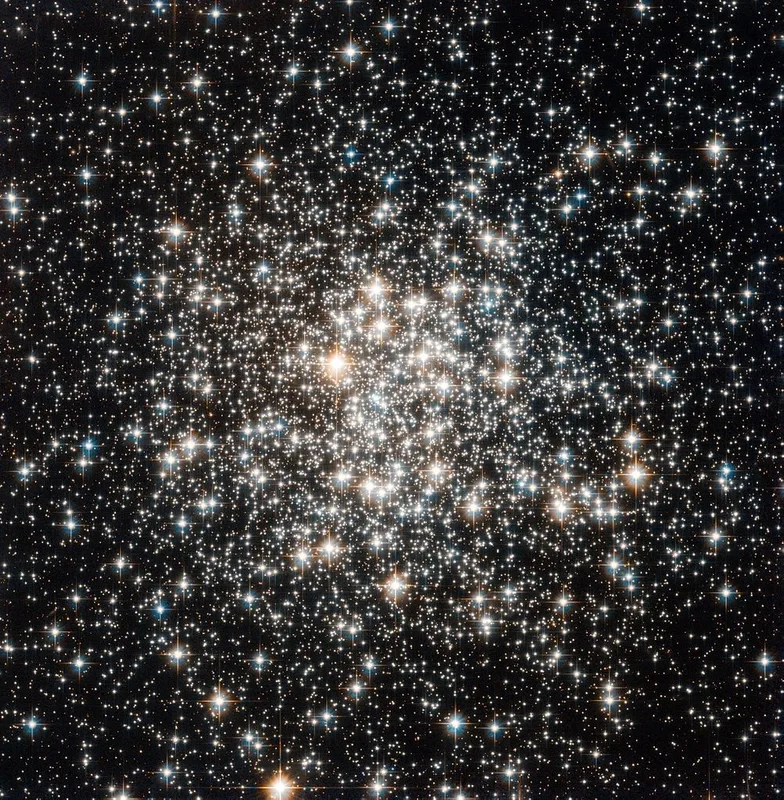
Highest numbered of the Messier globular clusters, M107 (NGC 6171) lies in southern Ophiuchus about 19,600 light-years away. It shines at magnitude 7.9 and is fairly loose, with dark lanes of dust visible in larger telescopes. Added to the catalog in the 20th century from Méchain's observations, it is less well known than M10 and M12 to the north.
Observing tips
Start at Zeta Ophiuchi, then move about 2.5 degrees south-southwest to M107. Binoculars show a faint, round haze. A 70 to 100 mm telescope at 80x reveals a soft glow with a slightly brighter center. With 200 mm at 150x, the cluster resolves into many faint stars, with a few dark gaps hinting at dust. From 52 degrees north it transits at about 25 degrees, so choose a clear, transparent night.
A small telescope under reasonably dark skies is a good starting point; use the live altitude chart to choose its highest point.
What to expect
M107 is an old globular cluster lying fairly close to the plane of the Milky Way, where interstellar dust dims and reddens its light. Its loose structure makes it easier to resolve than many denser globulars.
At about 8 to 10 arcminutes, M107 suits 1000 to 1200 mm. Short exposures preserve the core, while longer integration brings out the faint outer stars and the dust that crosses the field.