Observer's guide
About NGC 4258
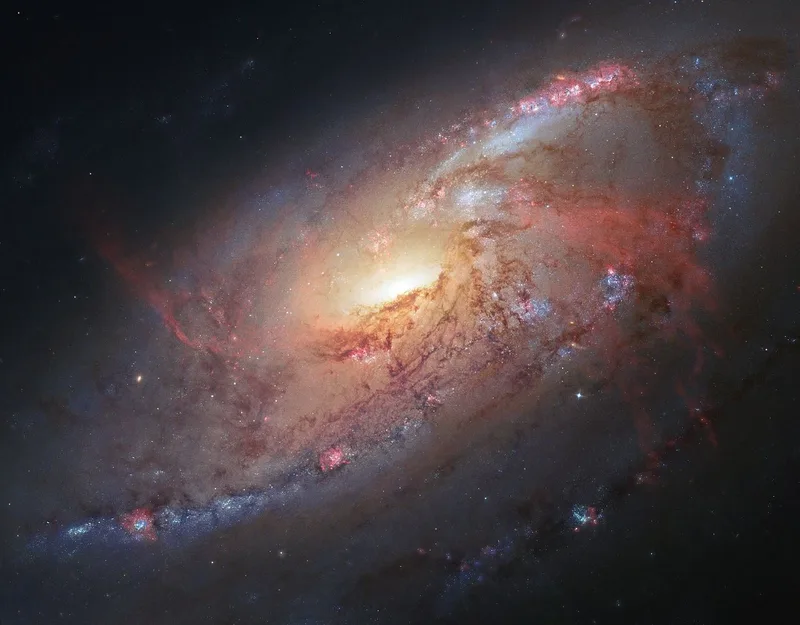
Large and bright, M106 (NGC 4258) is a spiral galaxy in Canes Venatici about 25 million light-years away, shining at magnitude 8.4. It measures about 18 by 7.9 arcminutes and shows a bright core in small telescopes. Professional astronomers know it for its water maser, which allowed a precise geometric distance measurement, and for extra arms that glow in radio and X-rays.
Observing tips
M106 lies roughly midway between Cor Caroli and Phecda (Gamma Ursae Majoris), close to the border with Ursa Major. Binoculars show an elongated glow under dark skies. A 70 to 100 mm telescope at 50x to 80x reveals a bright oval with a strong core. With 200 mm at 100x to 150x, the halo stretches out and you may see the brighter inner arms as faint extensions. It passes high overhead from mid-northern latitudes, which keeps atmospheric dimming to a minimum.
A small telescope under reasonably dark skies is a good starting point; use the live altitude chart to choose its highest point.
What to expect
M106 is a spiral galaxy with an active nucleus powered by a supermassive black hole. The anomalous arms seen in radio and X-ray images are thought to be gas heated by jets from the black hole rather than true spiral arms.
At about 18 arcminutes, M106 suits 600 to 1000 mm. Adding Ha data brings out the red anomalous arms, and long integration reveals its faint outer disk and nearby small galaxies such as NGC 4217.