Observer's guide
About NGC 581
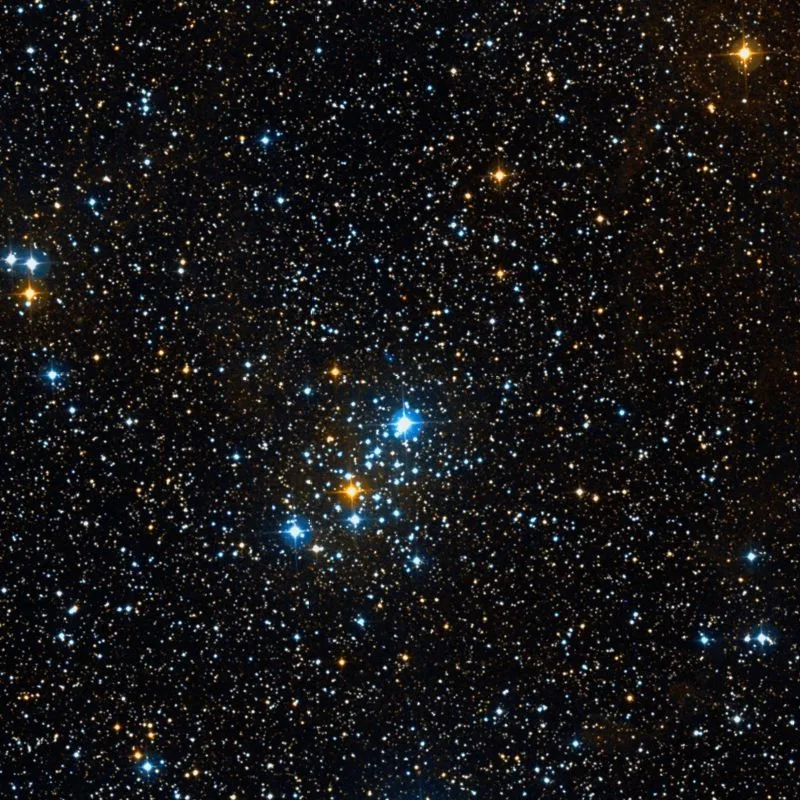
M103 (NGC 581) was the last object in Messier's final published catalog; the entries after it were added much later from his and Méchain's notes. This open cluster in Cassiopeia shines at magnitude 7.4, covers about 5 arcminutes, and lies about 8,000 light-years away. Its triangular shape and a reddish star near its center make it easy to recognize.
Observing tips
Start at Ruchbah (Delta Cassiopeiae), the second star from the eastern end of the W, and move about 1 degree east-northeast. Binoculars show a small, grainy patch. A 70 to 100 mm telescope at 50x to 80x shows about two dozen stars in a wedge or triangle shape, with a reddish star near the center. With 200 mm, more faint members fill in and the triangle looks richer. Several other small clusters lie nearby, so sweep the area slowly.
A small telescope under reasonably dark skies is a good starting point; use the live altitude chart to choose its highest point.
What to expect
M103 is a young open cluster, only a few tens of millions of years old, containing hot blue stars and a few evolved giants. It lies in the Perseus Arm of the Milky Way, which is rich in young clusters.
At about 5 arcminutes, M103 suits 800 to 1200 mm, while 300 to 400 mm captures it with NGC 654, NGC 659 and NGC 663. Keep exposures short enough to preserve star colors.