Observer's guide
About NGC 4321
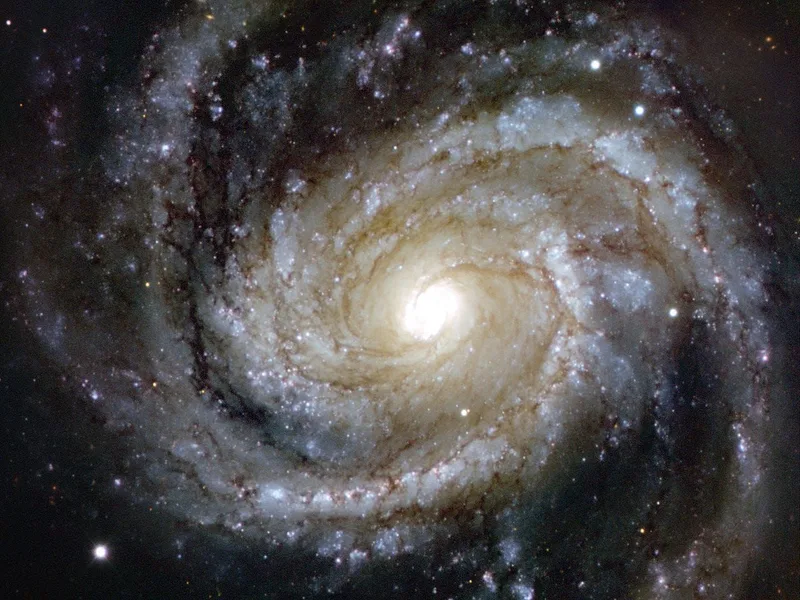
Seen almost face-on, M100 (NGC 4321) is a grand-design spiral in Coma Berenices and one of the largest galaxies in the Virgo Cluster. It shines at magnitude 9.3 about 60 million light-years away. In the 1990s, the Hubble Space Telescope used Cepheid variable stars in M100 to help measure the expansion rate of the universe.
Observing tips
From M99, move about 1.7 degrees north-northeast to find M100; it also lies about 2 degrees south of 11 Comae. Binoculars show at best a faint glow. A 70 to 100 mm telescope at 60x reveals a round, diffuse haze with a small, bright core. With 200 mm at 100x to 150x under a dark sky, the two main arms begin to show as brighter patches in the halo with averted vision. Its low surface brightness makes sky darkness more important than aperture.
Because it is faint, use a larger aperture where possible, avoid bright Moon conditions, and use averted vision.
What to expect
M100 is a grand-design spiral with two prominent arms and a ring of star formation around its core. Its arms are rich in young star clusters and dust, and it has hosted several observed supernovae.
At about 7 arcminutes, M100 suits 1000 to 1500 mm. Long integration with Ha data brings out the pink star-forming regions along its arms and the fine structure near the core.