Observer's guide
About Cave Nebula
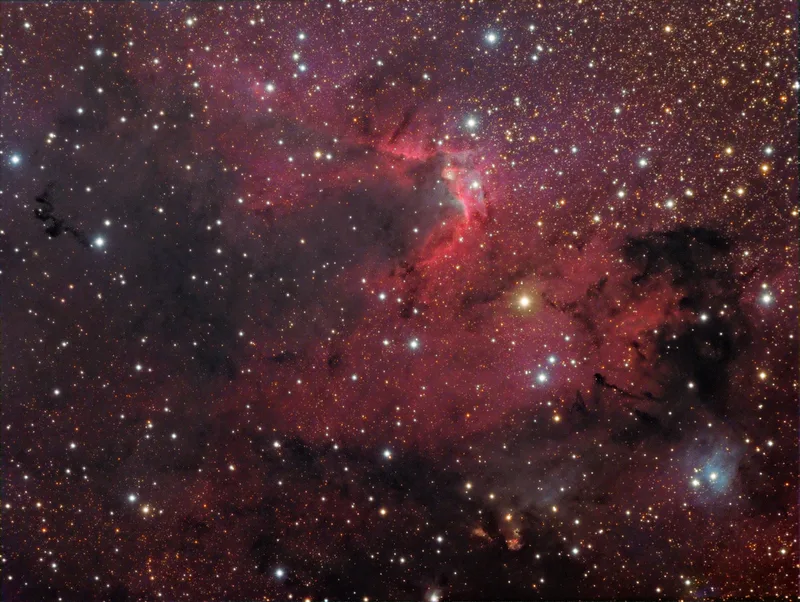
The Cave Nebula, Sh2-155 and Caldwell 9, is a faint emission nebula in Cepheus about 2,800 light-years away. Its name comes from a dark bay of dust that cuts into the glowing gas, giving the impression of a cave opening. The bright rim measures only a few arcminutes, but it sits on the edge of a much larger cloud of gas and dust. Visually it is one of the more difficult Caldwell objects.
Observing tips
Find Iota Cephei, the corner of the Cepheus house figure nearest Cassiopeia, and move a little under 4 degrees south. Binoculars do not show it. A 70–100 mm scope will rarely show more than a vague glow, even with a filter. In a 200 mm or larger telescope at 50–80x with a UHC filter, look for a faint arc of light bordering a darker region. A dark, transparent sky matters more than aperture here, and averted vision is essential.
Because it is faint, use a larger aperture where possible, avoid bright Moon conditions, and use averted vision.
What to expect
Sh2-155 is a region of hydrogen gas ionized by hot young stars of the Cepheus OB3 association. It marks the boundary where those stars are eroding a dense molecular cloud, and it combines glowing gas, reflecting dust and dark lanes.
Use 400–800 mm to show the bright rim with the surrounding dark nebulae. Hydrogen-alpha data does most of the work, and long total integration pays off in the faint outer gas.