Observer's guide
About NGC 6025
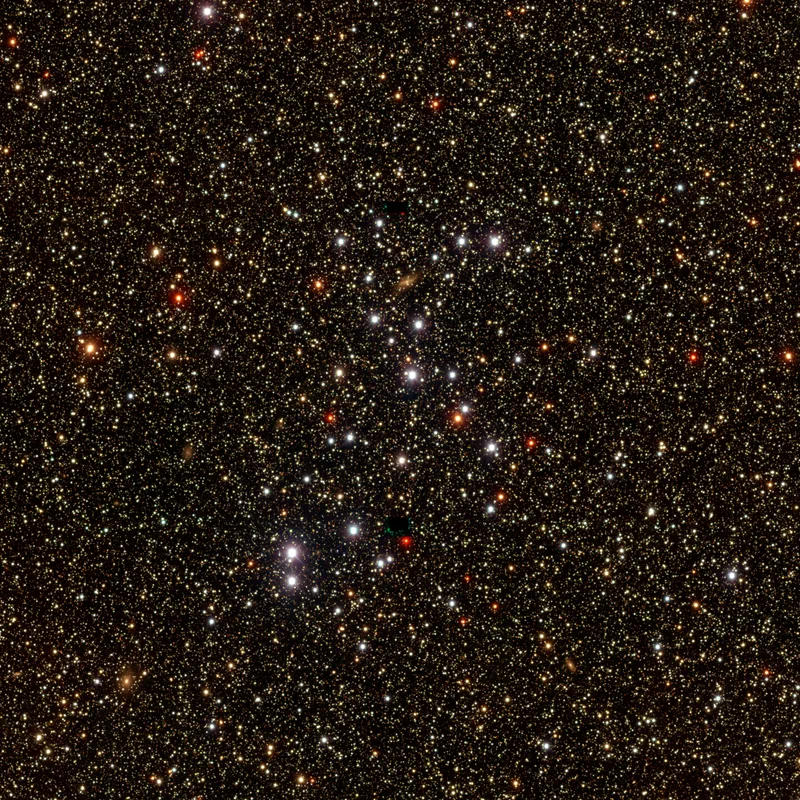
NGC 6025, Caldwell 95, is a bright open cluster in Triangulum Australe about 2,508 light-years away. At magnitude 5.1 it is visible to the naked eye from dark sites, and its bright stars form a loose, elongated group. It sits on the Norma border in a rich stretch of the southern Milky Way.
Observing tips
Start at Beta Trianguli Australis and move about 3° north. In binoculars the cluster appears as a group of bright stars in an elongated pattern. A 100 mm scope at 40x shows a few dozen stars, many of them bright and blue-white. A 200 mm telescope adds more faint stars, but the cluster is best at low power. NGC 6087 (Caldwell 89) is about 3° to the northeast, so you can sweep from one to the other. From 52°N it never rises; it is practical from about 20°N southward, best in May through July.
Its brightness makes it a practical binocular or small-telescope candidate when it is well above the horizon.
What to expect
NGC 6025 is a group of stars that formed together and still share the same motion through space. Its brightest members are hot blue-white stars, indicating a relatively young age.
At about half a degree, 400 to 700 mm frames the cluster; 200 to 300 mm can include NGC 6087. Aim for good color and a dark background to make the stars stand out.