Observer's guide
About NGC 6752
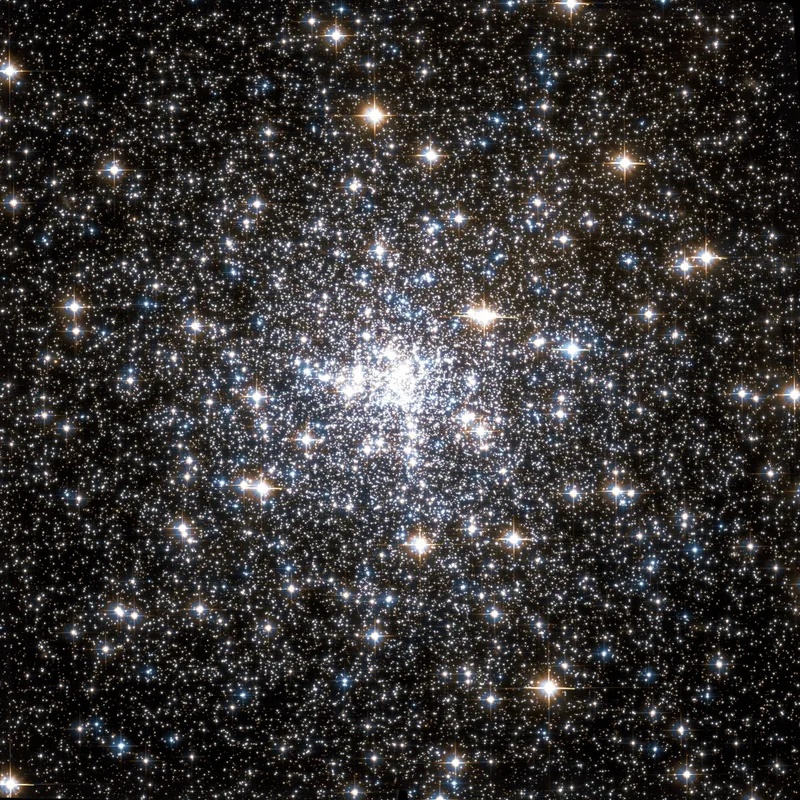
NGC 6752, Caldwell 93, is a bright globular cluster in Pavo about 13,000 light-years away. At magnitude 5.4 it is visible to the naked eye under dark skies and spans about 20 arcminutes. It is one of the brightest globular clusters, often ranked behind Omega Centauri and 47 Tucanae, with a dense core and long chains of stars in its halo.
Observing tips
From Lambda Pavonis, move about 3° northeast. In binoculars the cluster shows as a bright, round glow with a strong center. A 100 mm scope at 60x to 80x resolves the outer halo into many stars, and a 200 mm telescope reveals a dense core with chains of stars streaming outward. From 52°N it never rises; it is practical from about 20°N southward, best in July and August.
Its brightness makes it a practical binocular or small-telescope candidate when it is well above the horizon.
What to expect
NGC 6752 is an old globular cluster with a core that has likely collapsed. It contains many blue stragglers and has been closely studied for its multiple populations of stars with different chemical makeups.
At about 20 arcminutes, 600 to 1000 mm frames it well. Use short subexposures and careful processing to keep the dense core resolved.