Observer's guide
About Carina Nebula
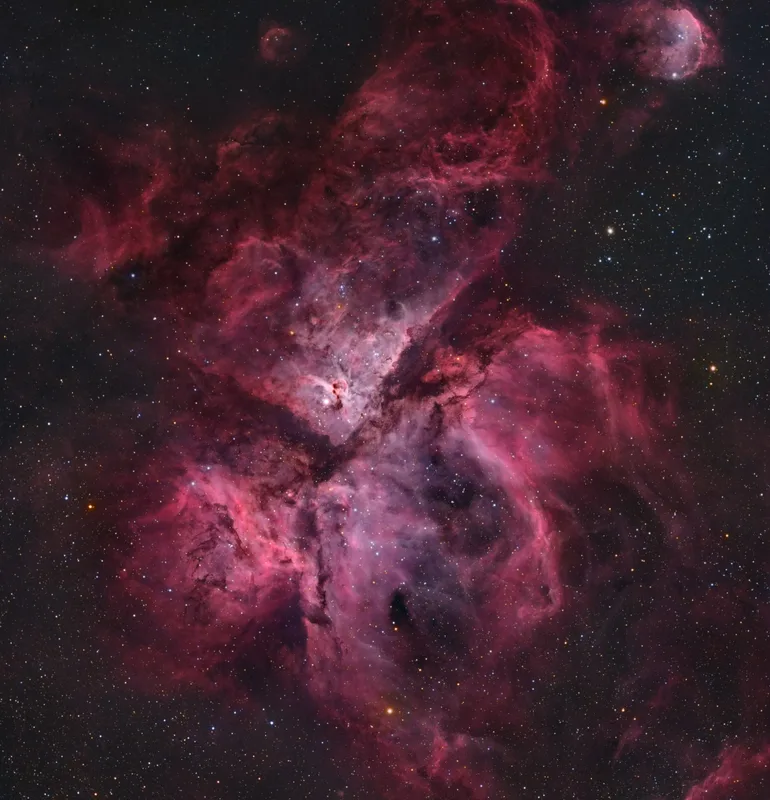
The Carina Nebula, NGC 3372 or Caldwell 92, is one of the largest and brightest emission nebulae in the sky, about 7,500 light-years away in Carina. It is much larger in the sky than the Orion Nebula and contains the massive, unstable star Eta Carinae. The nebula is easy to see with the naked eye, glowing as a bright patch in the southern Milky Way.
Observing tips
Find it by following the Milky Way from the Southern Cross toward the False Cross; it is the bright patch roughly between them, and Eta Carinae appears as an orange star at its heart. In binoculars the nebula shows dark lanes splitting its glow and several clusters around it. A 100 mm scope shows the V-shaped dark lane and the Keyhole near Eta, and a UHC or OIII filter increases contrast. With 200 mm or more at moderate power, the brightest parts show detailed structure, and Eta Carinae may appear as a tiny orange disk, the Homunculus. From 52°N it never rises; it is practical from about 20°N southward, best in February through April.
Its brightness makes it a practical binocular or small-telescope candidate when it is well above the horizon.
What to expect
The nebula is a huge region of star formation lit by several young clusters, including Trumpler 14 and Trumpler 16, which hold some of the most massive stars known. Eta Carinae, one of them, underwent a great eruption in the 1840s that created the Homunculus nebula around it.
The nebula spans more than a degree, so 200 to 500 mm frames the whole complex. Narrowband H-alpha, OIII and SII data bring out structure in the bright core; short exposures keep Eta Carinae from saturating.