Observer's guide
About NGC 2867
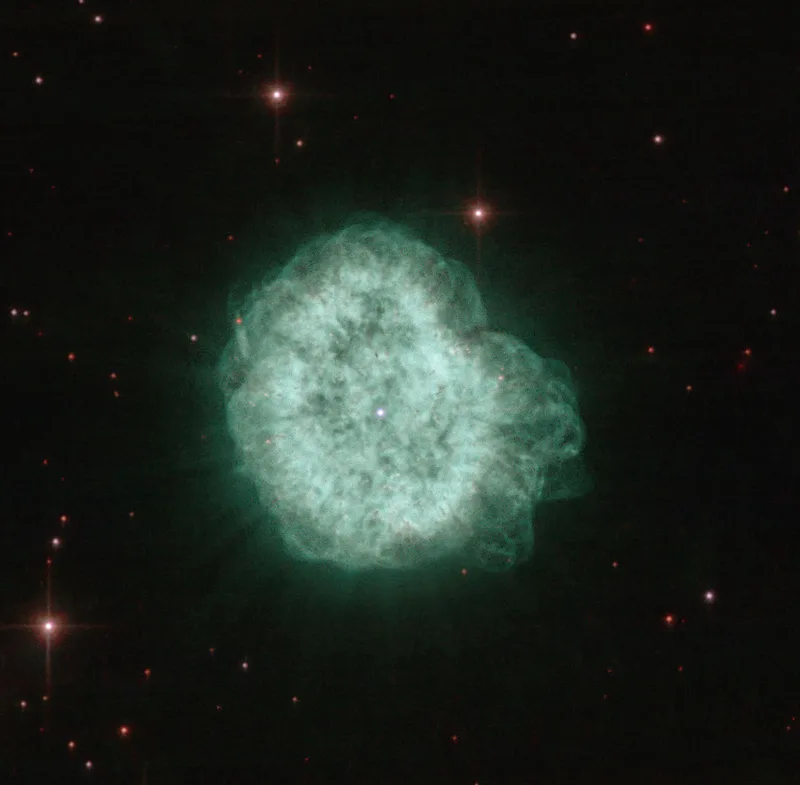
NGC 2867, Caldwell 90, is a small, bright planetary nebula in Carina, about 5,500 light-years away. Its central star is a hot Wolf-Rayet type, and the nebula glows with a strong blue-green color. At magnitude 9.7 and only about a quarter of an arcminute across, it looks nearly stellar at low power.
Observing tips
Find Iota Carinae (Aspidiske), part of the False Cross, and move about 1° north-northeast. Binoculars show only a faint star. A 100 mm scope at 100x shows a small, slightly fuzzy disk; blinking with an OIII filter helps confirm it. A 200 mm telescope at 200x to 300x shows a round disk with a pale blue-green tint and possibly the central star. From 52°N it never rises; it is practical from about 22°N southward, best in February through April.
Because it is faint, use a larger aperture where possible, avoid bright Moon conditions, and use averted vision.
What to expect
NGC 2867 is the ejected outer layers of a dying star, ionized by a central star of the Wolf-Rayet class that has lost its hydrogen. These hydrogen-poor central stars are hotter and blow faster winds than most planetary nebula nuclei.
This is a tiny target, so use 2000 mm or more and good seeing. Short exposures with OIII and H-alpha will capture the bright disk and its faint shell.