Observer's guide
About NGC 6397
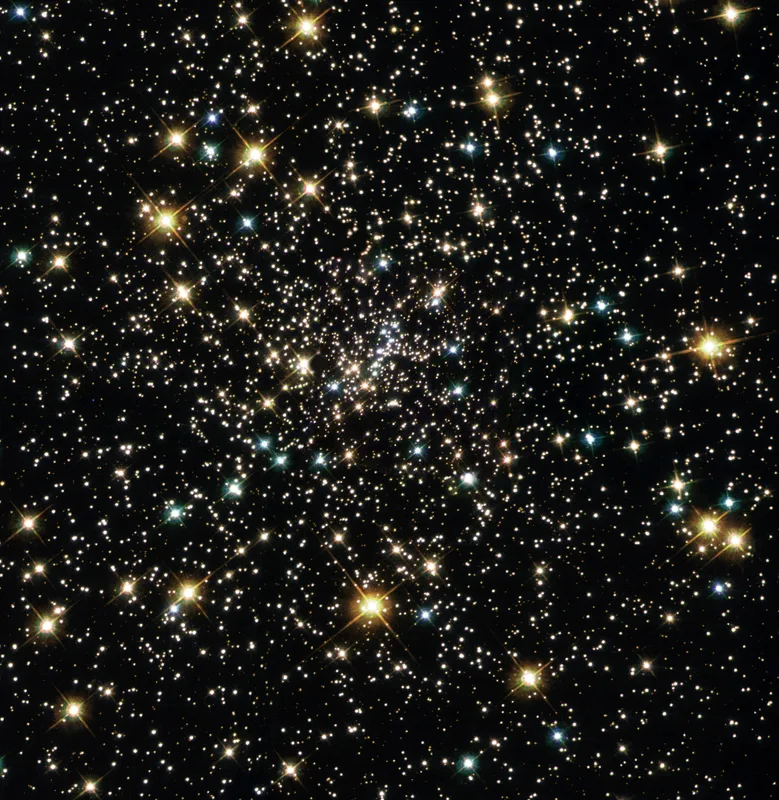
NGC 6397, Caldwell 86, is one of the nearest globular clusters to Earth, about 7,800 light-years away in Ara. At magnitude 5.7 it is visible to the naked eye under dark skies and spans about 26 arcminutes. Its core has undergone collapse, packing stars very tightly at the center, while its outer stars are loose and easily resolved.
Observing tips
From Beta Arae, move about 3° northeast. In binoculars it is a large, bright glow, slightly elongated, with some stars resolved at the edges. A 100 mm scope at 60x shows many resolved stars across the halo, with chains of stars running out from the center. In a 200 mm telescope it breaks into a dense field of stars right to the core. From 52°N it never rises; it is practical from about 26°N southward, best in June and July.
Its brightness makes it a practical binocular or small-telescope candidate when it is well above the horizon.
What to expect
NGC 6397 is an old globular cluster whose core has collapsed, a stage where stellar encounters concentrate stars toward the center. Its nearness lets astronomers detect faint white dwarfs and very low-mass stars, which are used to estimate the cluster's age.
At about 26 arcminutes, 500 to 900 mm frames the cluster well. Good seeing and careful stretching reveal the dense core and the outlying star chains.