Observer's guide
About NGC 5286
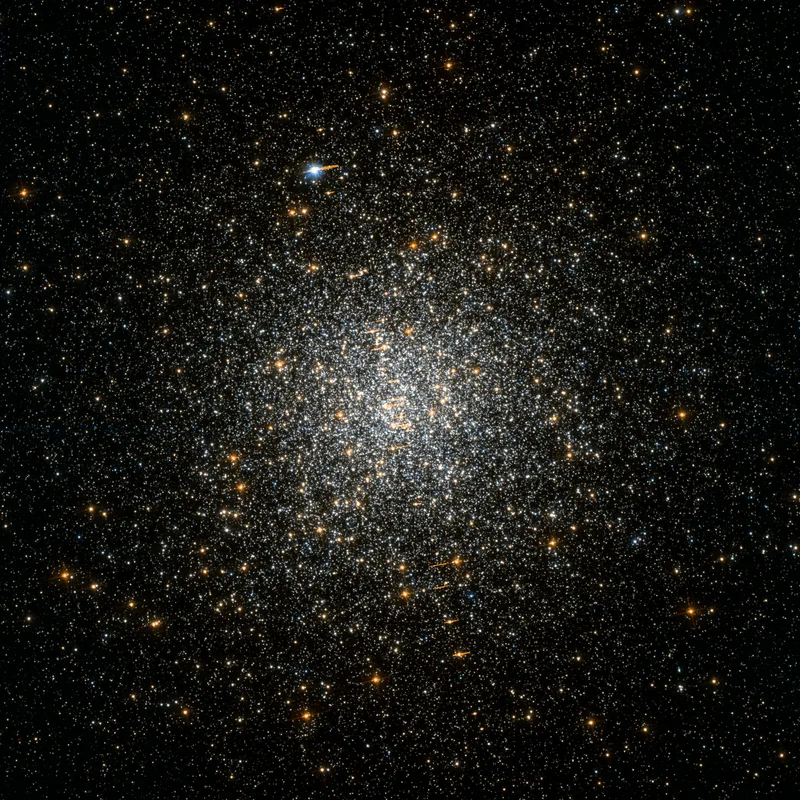
NGC 5286, Caldwell 84, is a compact globular cluster in Centaurus about 36,000 light-years away. At magnitude 7.6 and roughly 9 arcminutes across, it is a fairly concentrated cluster that looks bright for its size. It lies not far from the plane of the Milky Way in a star-rich field.
Observing tips
Start at Epsilon Centauri and move about 2° north. In binoculars it shows as a small, fuzzy spot. A 100 mm scope at 100x reveals a round glow with a bright center and a slightly grainy edge. In a 200 mm telescope the outer halo resolves into faint stars while the core remains dense. From 52°N it never rises; it is practical from about 29°N southward, best in April and May.
A small telescope under reasonably dark skies is a good starting point; use the live altitude chart to choose its highest point.
What to expect
NGC 5286 is an old, metal-poor globular cluster orbiting in the Milky Way's halo. Like most globulars, it contains RR Lyrae variables, pulsating stars whose known brightness helps astronomers measure the cluster's distance.
About 9 arcminutes across, it suits 1200 to 2000 mm. Aim for good seeing to resolve the outer stars and short subframes to keep the core under control.