Observer's guide
About NGC 4945
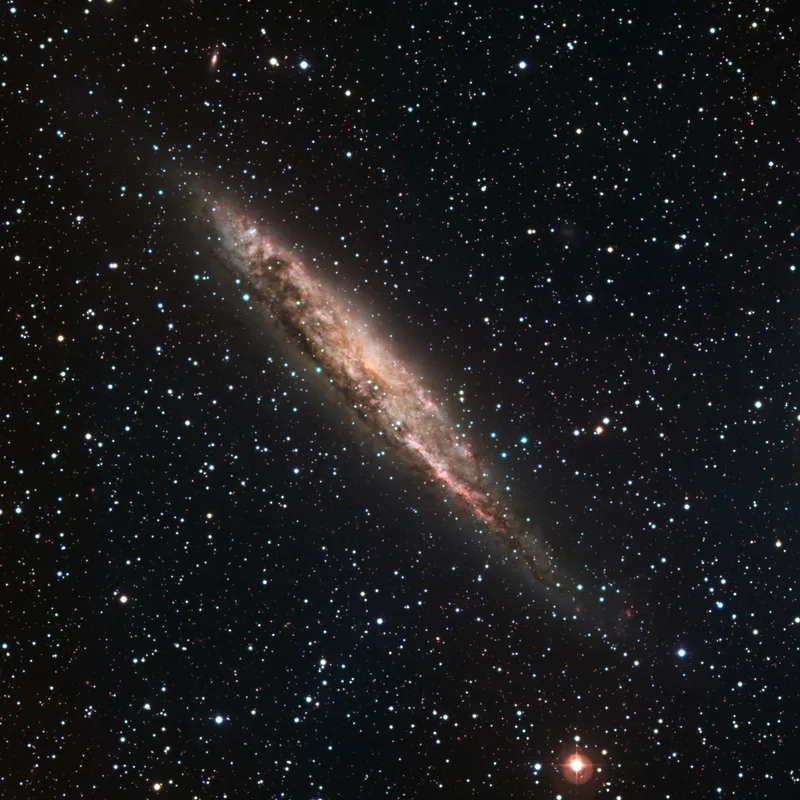
NGC 4945, Caldwell 83, is a large spiral galaxy seen nearly edge-on in Centaurus, about 17 million light-years away. It stretches over 20 arcminutes, but dust and the low surface brightness of its disk keep it faint. Its active Seyfert nucleus is hidden behind dust in visible light. It belongs to the same galaxy group as Centaurus A.
Observing tips
The galaxy sits right beside the stars Xi1 and Xi2 Centauri, about 4° west-southwest of Omega Centauri. In binoculars it may be glimpsed as a faint streak under dark skies. A 100 mm scope shows a long, thin glow running northeast to southwest. With 200 mm at 100x, the uneven brightness and dust become clearer, along with a slightly brighter core. From 52°N it never rises; it is practical from about 30°N southward, best in April and May.
Because it is faint, use a larger aperture where possible, avoid bright Moon conditions, and use averted vision.
What to expect
NGC 4945 is a barred spiral with a starburst in its center and a supermassive black hole that is one of the brightest sources of hard X-rays in the sky. Its edge-on view and dust make it a nearby case study of an obscured active nucleus.
At about 20 by 4 arcminutes, it frames well at 700 to 1200 mm. Long integration reveals the dust lanes and faint outer disk; the two Xi Centauri stars can be included with care to control their glare.