Observer's guide
About Omega Centauri
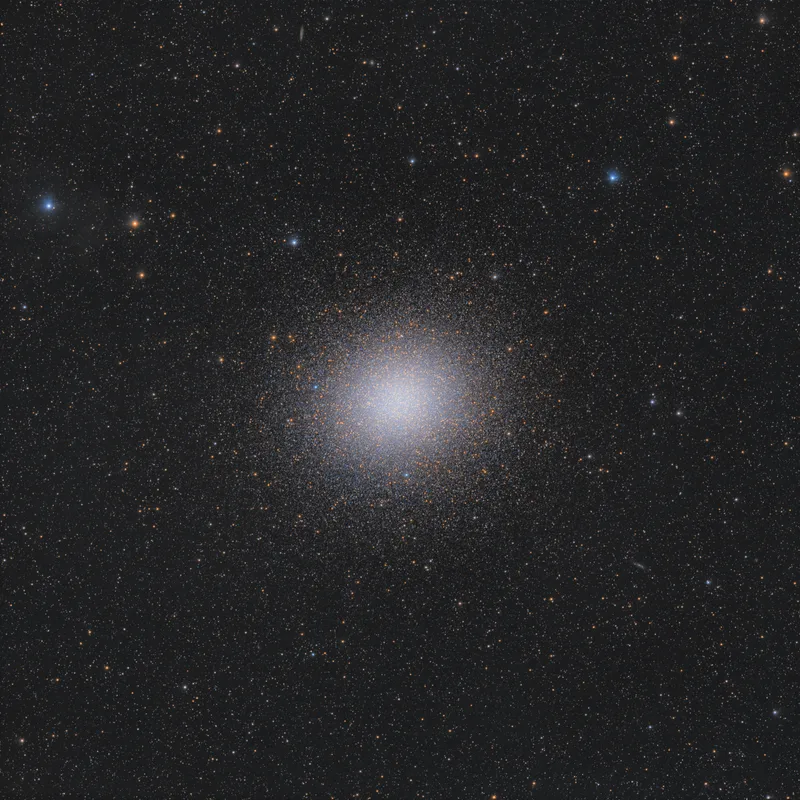
Omega Centauri, NGC 5139 or Caldwell 80, is the largest and brightest globular cluster in the Milky Way. It lies about 17,000 light-years away in Centaurus and shines at magnitude 3.7, so it is plainly visible to the naked eye as a fuzzy star. Edmond Halley noted its nebulous look in 1677. Its glow spans about 36 arcminutes, larger than the full Moon.
Observing tips
Look about 5° west of Zeta Centauri. To the naked eye it looks like a hazy 4th-magnitude star. In binoculars it becomes a big, round glow with a bright center, and a 100 mm scope at 60x resolves countless stars across its face. In a 200 mm telescope it fills the field with a dense ball of stars with dark lanes and arcs. From 52°N it never rises; it reaches the horizon only south of about 42°N and is practical from about 32°N southward, including southern Texas and Florida, best in April and May.
Its brightness makes it a practical binocular or small-telescope candidate when it is well above the horizon.
What to expect
Omega Centauri contains millions of stars of differing ages and chemical compositions, unlike most globulars. Many astronomers think it is the remnant core of a dwarf galaxy captured and stripped by the Milky Way long ago.
At 36 arcminutes it fills the field at 500 to 800 mm, or frame it with more surroundings at 300 to 400 mm. Use short exposures and careful stretching so the dense core remains resolved and star colors stay natural.