Observer's guide
About NGC 2403
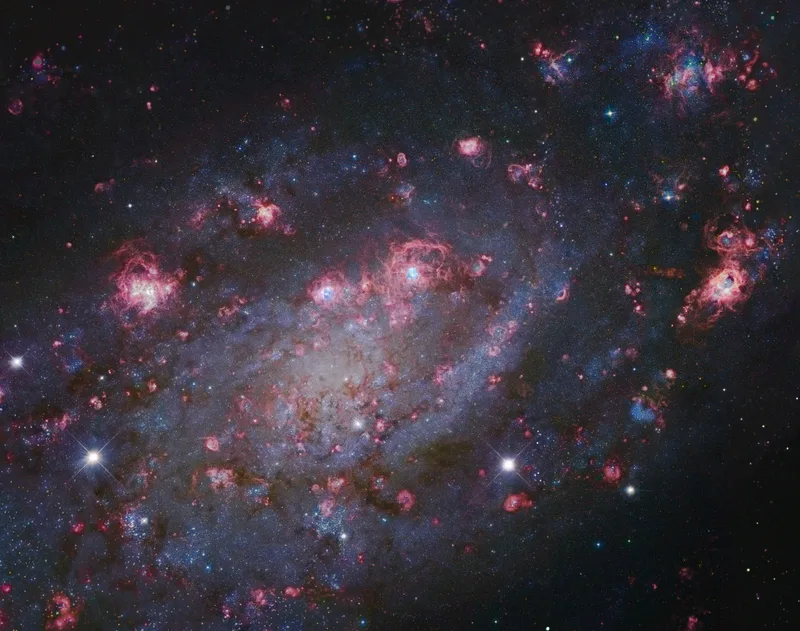
NGC 2403, Caldwell 7, is a bright spiral galaxy in Camelopardalis and one of the easier galaxies in the far northern sky. At magnitude 8.9 and about 10 by 6 arcminutes, it shows real structure in moderate telescopes. It lies roughly 14 million light-years away and is usually treated as an outlying member of the M81 group. Large star-forming regions are scattered through its arms.
Observing tips
Start from Omicron Ursae Majoris, the star at the Great Bear's nose, and move about 8 degrees northwest. Under dark skies binoculars show a small oval glow. A 70–100 mm telescope at 40–60x shows an elongated haze with a brighter center. With 200 mm or more at 100x, the disk turns mottled, and the brightest knot, the star-forming region NGC 2404, can stand out within it. Patience and averted vision bring out more of the faint outer arms.
A small telescope under reasonably dark skies is a good starting point; use the live altitude chart to choose its highest point.
What to expect
NGC 2403 is a loosely wound spiral with no strong bar, rich in gas and young stars. Its brightest star-forming region is large enough to carry its own catalog number, NGC 2404, and it is visible in amateur telescopes from 14 million light-years away.
At about 10 arcminutes long, it frames well at 800–1,500 mm. Add hydrogen-alpha data to the color image to make the pink star-forming regions along the arms stand out.