Observer's guide
About Centaurus A
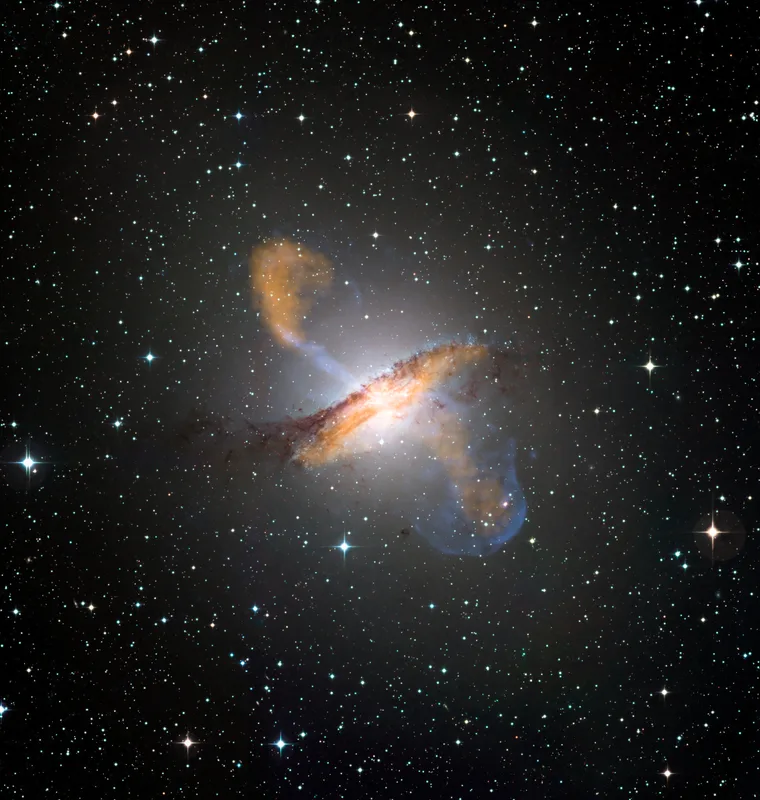
Centaurus A, NGC 5128 or Caldwell 77, is a giant galaxy in Centaurus about 10 million light-years away, crossed by a broad, dark dust lane. It is one of the strongest radio sources in the sky and the nearest large galaxy with an active nucleus. At magnitude 6.8 it is also one of the brightest galaxies in the southern sky, and its dust lane is visible in small telescopes.
Observing tips
From Omega Centauri, move about 4.5° north. In 10x50 binoculars it is a small, round glow, and a 100 mm scope shows an oval haze with a dark band cutting across its middle. In a 200 mm telescope at 100x the dust lane becomes obvious and uneven. From 52°N it never rises; it is practical from about 35°N southward, so the southern US is the northern limit for good views, and it is best in April and May.
A small telescope under reasonably dark skies is a good starting point; use the live altitude chart to choose its highest point.
What to expect
NGC 5128 is a massive elliptical-like galaxy with a disk of dust and gas, probably the remains of a smaller spiral galaxy it absorbed. A supermassive black hole at its center launches jets that feed huge radio lobes extending far beyond the visible galaxy.
At about 26 by 18 arcminutes, 800 to 1200 mm frames the galaxy with room for its faint outer halo. Aim to resolve the dust lane while capturing the extended shells with long total integration.