Observer's guide
About Eight-Burst Nebula
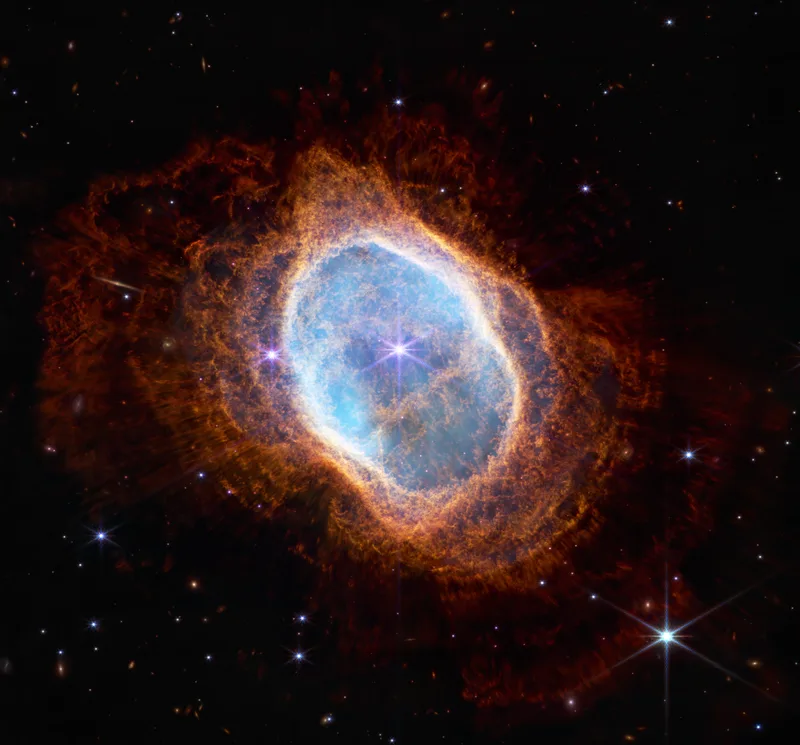
NGC 3132, Caldwell 74, is a bright planetary nebula in Vela near the Antlia border, called the Eight-Burst Nebula or the Southern Ring Nebula. It is about 2,000 light-years away. A 10th-magnitude star sits at its center, but it is not the star that made the nebula; that role belongs to a faint white dwarf companion right next to it. It was among the first images released by the James Webb Space Telescope in 2022.
Observing tips
The nebula lies near the Antlia border in an area with few bright stars, so a finder chart or GoTo mount saves time. At magnitude 9.9 and under an arcminute across, binoculars show only a faint star. A 100 mm scope at 100x reveals an oval glow around the bright central star. With 200 mm at 150x to 250x the oval shows a brighter rim and some inner structure, and an OIII or UHC filter improves contrast, though it also dims the central star. From 52°N it never rises; it is practical from about 40°N southward, best in February and March.
Because it is faint, use a larger aperture where possible, avoid bright Moon conditions, and use averted vision.
What to expect
The shell is gas lost by a dying star now seen only as a faint white dwarf beside the brighter A-type star. Webb's infrared images show several nested shells and dust around the white dwarf.
This is a small target, so use 1500 mm or more of focal length and good seeing. H-alpha and OIII exposures will show the bright inner shell and the fainter outer rings.