Observer's guide
About NGC 1851
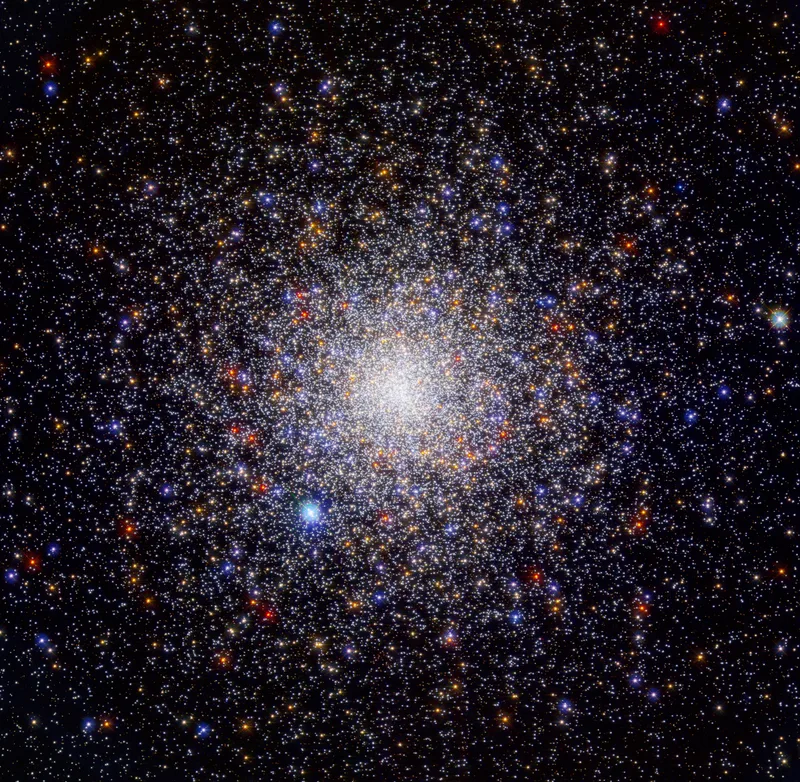
NGC 1851, or Caldwell 73, is a bright, compact globular cluster in Columba, about 39,400 light-years away. At magnitude 7.3 it stands out in a part of the sky with few other bright deep-sky objects. Its very dense core makes it look almost starlike at low power, and detailed studies have shown it contains more than one generation of stars.
Observing tips
The cluster lies in southwestern Columba, about 8° south-southwest of Phact (Alpha Columbae). In binoculars it is a small, fuzzy star. A 100 mm scope at 100x shows a bright, concentrated core inside a round halo, with a few stars resolved at the edges. In a 200 mm telescope at 200x the outer halo breaks into many faint stars, though the core stays a solid glow. From 52°N it never rises; it is practical from about 40°N southward, best in December and January.
A small telescope under reasonably dark skies is a good starting point; use the live altitude chart to choose its highest point.
What to expect
NGC 1851 is an old, massive globular cluster with a highly concentrated core. Its stars split into distinct groups with different chemical compositions, evidence that it formed in more than one burst.
The cluster spans about 11 arcminutes, so 1000 to 1500 mm works well. Use short exposures to keep the core from saturating and longer ones to show the outer stars.