Observer's guide
About NGC 2477
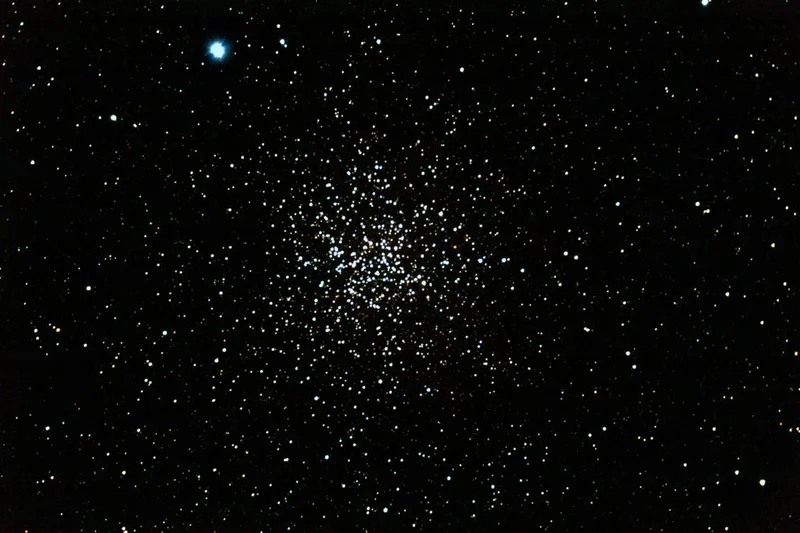
NGC 2477, Caldwell 71, is one of the richest open clusters in the southern sky, a dense swarm of stars in Puppis about 3,700 light-years away. At magnitude 5.8 and about 18 arcminutes across, it has hundreds of members packed so closely that it resembles a loose globular cluster. Its stars are fairly old for an open cluster, and it pairs nicely with the brighter, sparser NGC 2451 nearby.
Observing tips
Start at Naos (Zeta Puppis) and move about 2.7° northwest. The open cluster NGC 2451 lies about 1.5° away, so you can sweep both in one binocular field. In 10x50 binoculars NGC 2477 is a round, grainy glow. A 100 mm scope at 50x resolves many faint stars over a misty background, while a 200 mm telescope turns it into a field of hundreds of stars. From 52°N it never clears the horizon; it is practical south of about 40°N, best in January and February.
Its brightness makes it a practical binocular or small-telescope candidate when it is well above the horizon.
What to expect
NGC 2477 contains many red giants and white dwarfs, signs of an intermediate-age population. Astronomers use it to test how stars like the Sun evolve and how white dwarfs cool over time.
An 18 arcminute cluster sits well at 600 to 900 mm, or use about 300 mm to include NGC 2451. Aim for small, sharp stars and good color to separate the yellow giants from the many white members.