Observer's guide
About NGC 300
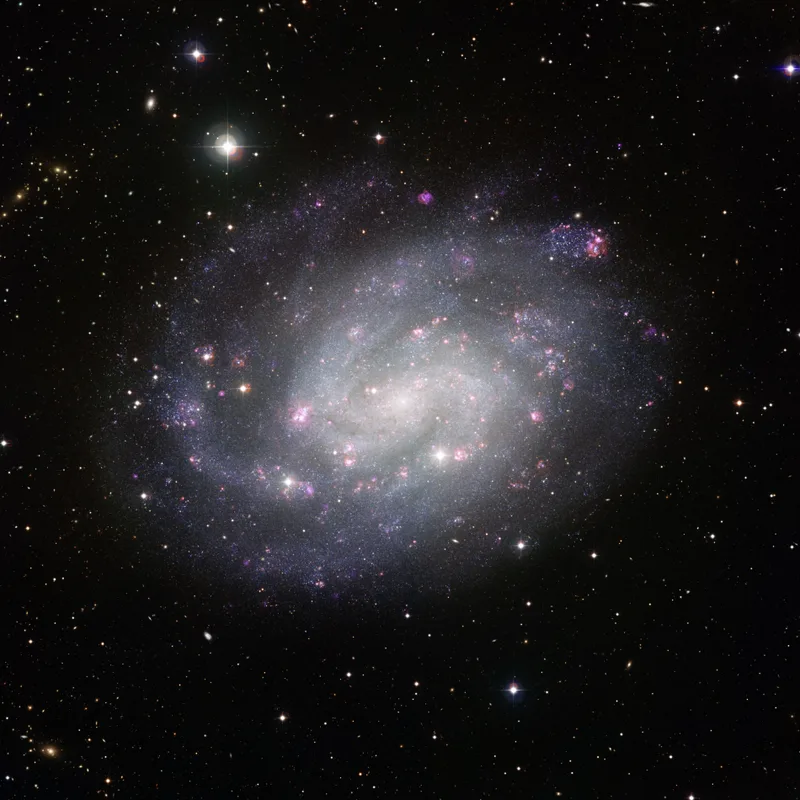
NGC 300, Caldwell 70, is a nearly face-on spiral galaxy in Sculptor about 3.9 million light-years away, one of the nearest spirals beyond the Local Group. It is large, around 21 by 13 arcminutes, but its low surface brightness makes it surprisingly hard to see despite a magnitude of 8.1. Its open spiral arms are rich in star-forming regions, and its Cepheid variables have made it a key distance benchmark.
Observing tips
From Ankaa (Alpha Phoenicis), move about 7° northeast into southern Sculptor. In binoculars under dark skies you may see a large, very faint oval glow. A 100 mm scope at low power shows a broad, diffuse haze with a slightly brighter center and little else. With 200 mm or more on a dark, transparent night the spiral arms show as uneven patches, and some knots of star formation appear. From 52°N it reaches only about 0.3°, so it is practical only from about 35°N southward, best in September and October.
A small telescope under reasonably dark skies is a good starting point; use the live altitude chart to choose its highest point.
What to expect
NGC 300 is a gas-rich spiral with little central bulge, similar in type to the Triangulum Galaxy. Studies of its Cepheids and star-forming regions make it one of the better-measured galaxies outside the Local Group.
At about 21 by 13 arcminutes, 500 to 800 mm frames the full disk. Add H-alpha data to the color image to bring out the pink HII regions scattered along the arms.