Observer's guide
About Cat's Eye Nebula
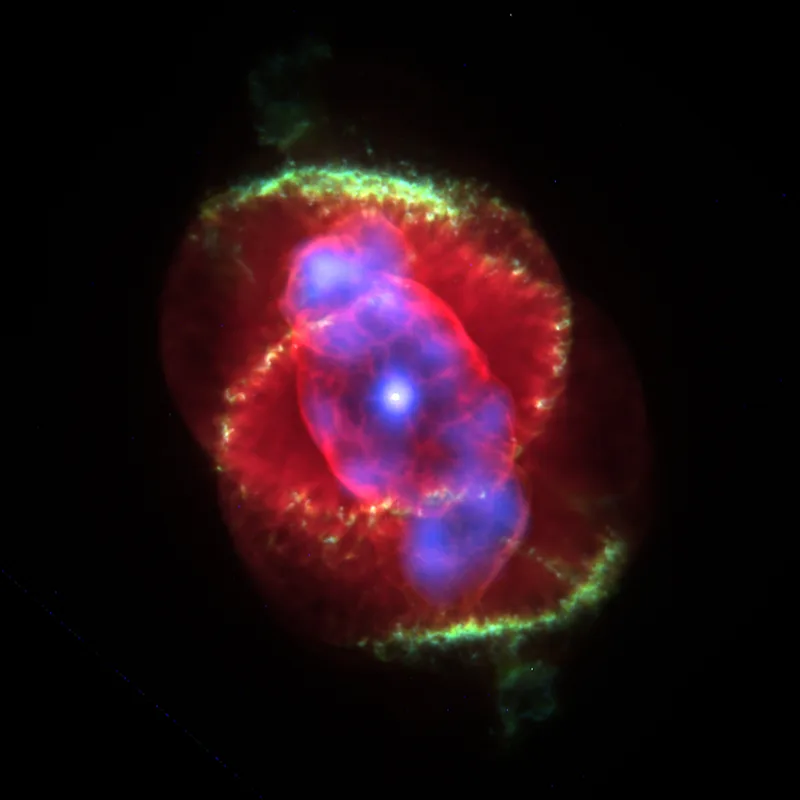
The Cat's Eye Nebula, NGC 6543 or Caldwell 6, is one of the brightest planetary nebulae in the northern sky. It lies in Draco, close to the north ecliptic pole, and shines at magnitude 8.1 despite being only about 0.6 arcminutes across. Hubble images revealed a complex set of shells and jets within it, and it remains one of the most studied objects of its kind.
Observing tips
Look roughly halfway between Delta and Zeta Draconis. The nebula sits in a sparse field, and at low power it looks like a slightly fuzzy star. Binoculars show only a starlike point. In a 70–100 mm scope at 100x it becomes a small, blue-green oval disk. A 200 mm telescope at 200–300x shows the central star and a brighter inner region within the disk on nights of steady air. It takes high magnification well, and an OIII filter blinked in and out confirms it quickly.
A small telescope under reasonably dark skies is a good starting point; use the live altitude chart to choose its highest point.
What to expect
NGC 6543 consists of gas shed by a dying Sun-like star in several episodes, now lit by the hot central star. The concentric rings seen in deep images record separate outbursts, while a faint outer halo marks older material lost earlier.
The bright core needs 2,000 mm or more and short exposures to avoid burning out the center. Separate long exposures through OIII or hydrogen-alpha filters can capture the faint outer halo.