Observer's guide
About Bug Nebula
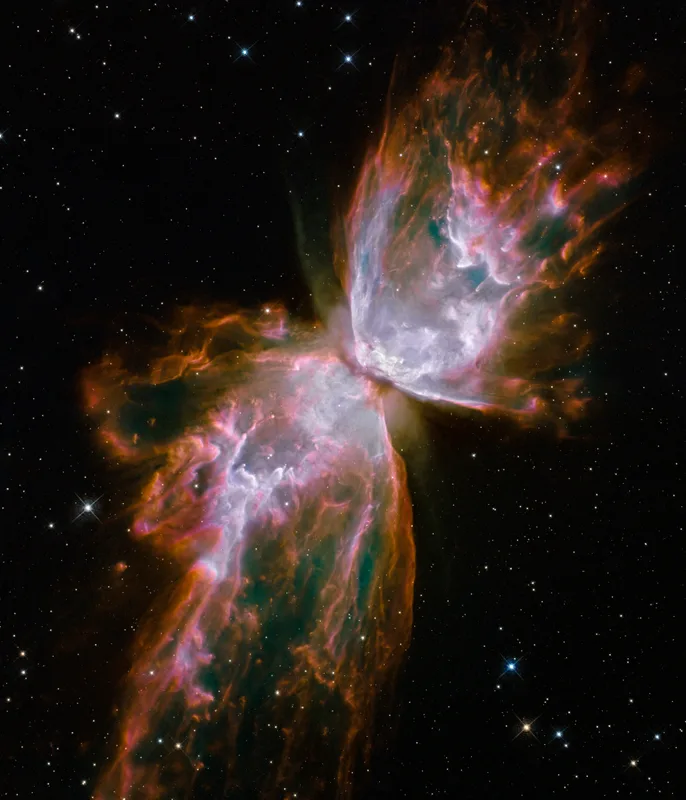
NGC 6302, Caldwell 69, is a bipolar planetary nebula in Scorpius, known as the Bug Nebula or Butterfly Nebula, about 5,200 light-years away. A thick, dusty band hides its central star, while lobes of gas stream out on either side. The star inside is one of the hottest known at the heart of any planetary nebula, yet it stays hidden from view behind that dust.
Observing tips
Find Shaula (Lambda Scorpii) in the scorpion's stinger and move about 3° due west. With a bright core only half an arcminute across and a magnitude of 9.6, it looks stellar in binoculars. A 100 mm scope at 100x or more shows a small, elongated glow. In a 200 mm telescope at 200x the bright central bar and a hint of the lobes appear, and a UHC or OIII filter helps bring out the fainter extensions. From 52°N it only reaches about 1°, so it is a target for latitudes south of about 40°N, best in June and July.
Because it is faint, use a larger aperture where possible, avoid bright Moon conditions, and use averted vision.
What to expect
The lobes are gas thrown off by a dying star, pinched into an hourglass by the dense ring of dust and gas around its waist. That dusty torus contains crystalline silicates and other grains, and the central star is extremely hot.
The bright core is small, but the faint lobes extend well beyond it, so 1500 to 2500 mm works well. H-alpha, OIII and SII data show the structure; keep exposures short enough to hold detail in the bright center.