Observer's guide
About NGC 5694
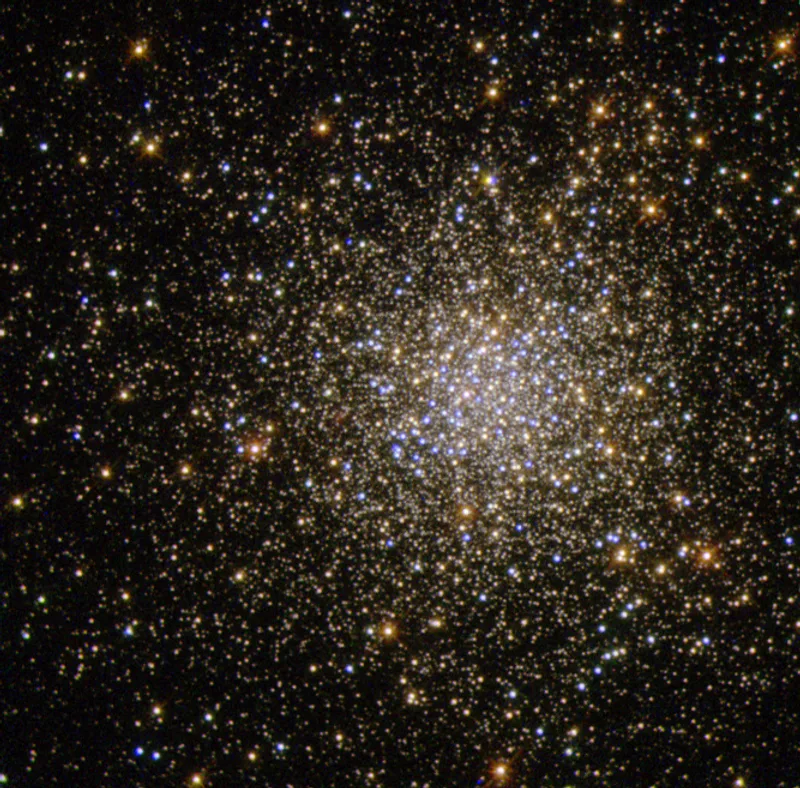
NGC 5694, or Caldwell 66, is a small and remote globular cluster in Hydra, about 113,000 light-years from us. That puts it far out in the Milky Way's halo, much more distant than most globulars within reach of amateur telescopes. Its compact, nearly starlike look and sparse surroundings make it more of a hunting challenge than a visual spectacle, but it is a satisfying catch.
Observing tips
The cluster lies about 7° east of Pi Hydrae, near the Libra border, in a sparse area with few guide stars, so a finder chart or GoTo mount helps. At magnitude 10.2 and 3.6 arcminutes across it is beyond binoculars. A 100 mm scope shows a small, round, fuzzy spot that can pass for an out-of-focus star. In a 200 mm telescope at 150x it shows a brighter core and a faint halo, but its stars stay unresolved in typical amateur instruments. From 52°N it transits at about 11°, so it suits southern Europe, the southern US or the Southern Hemisphere, best in April and May.
Because it is faint, use a larger aperture where possible, avoid bright Moon conditions, and use averted vision.
What to expect
Like other globular clusters, NGC 5694 is a dense ball of very old stars orbiting in the halo of the Milky Way. Its radial velocity of about 139 km/s toward us reflects an orbit quite unlike that of stars in the galactic disk.
A cluster just 3.6 arcminutes across needs 1500 mm or more of focal length. Aim for good seeing and short subexposures to keep the core from saturating while still showing the faint outer halo.