Observer's guide
About Sculptor Galaxy
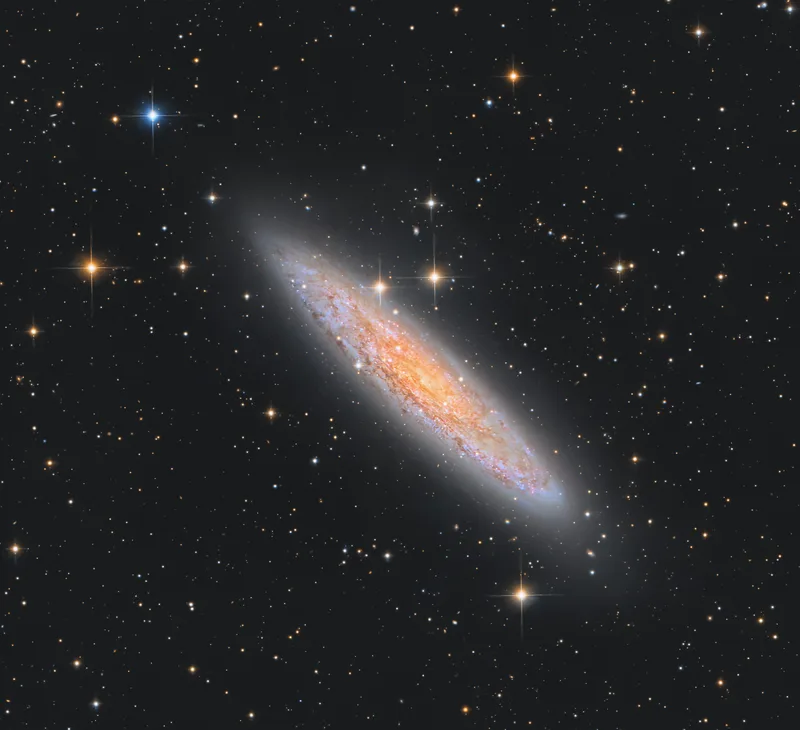
The Sculptor Galaxy, NGC 253 or Caldwell 65, is one of the brightest galaxies beyond the Local Group. It lies about 9.8 million light-years away in Sculptor, where its long, dusty disk is seen almost edge-on, and it is the largest member of the Sculptor Group. Caroline Herschel discovered it in 1783. At magnitude 7.1 it is bright enough for binoculars, which few galaxies this far south can claim.
Observing tips
From Deneb Kaitos (Beta Ceti) go about 7° south; the galaxy lies just across the border in Sculptor. In 10x50 binoculars it shows as a thin, elongated glow. A 100 mm scope shows a cigar-shaped streak nearly half a degree long with a mottled texture. In a 200 mm telescope at 100x, dust lanes break the disk into patches, and the globular cluster NGC 288 is about 2° to the southeast. From 52°N it transits at only about 13°, so chase it in September from a site with a flat southern horizon; from the southern US and southward it is excellent.
A small telescope under reasonably dark skies is a good starting point; use the live altitude chart to choose its highest point.
What to expect
NGC 253 is a starburst galaxy, forming stars much faster than the Milky Way in a compact region near its center. Supernovae and stellar winds there drive a wind of hot gas out of the disk. It is classed as a barred spiral.
At nearly 29 arcminutes long, it frames well at 500 to 1000 mm. Aim for enough integration to show the dark dust lanes and the faint outer disk, which extends well beyond the bright central body.