Observer's guide
About Helix Nebula
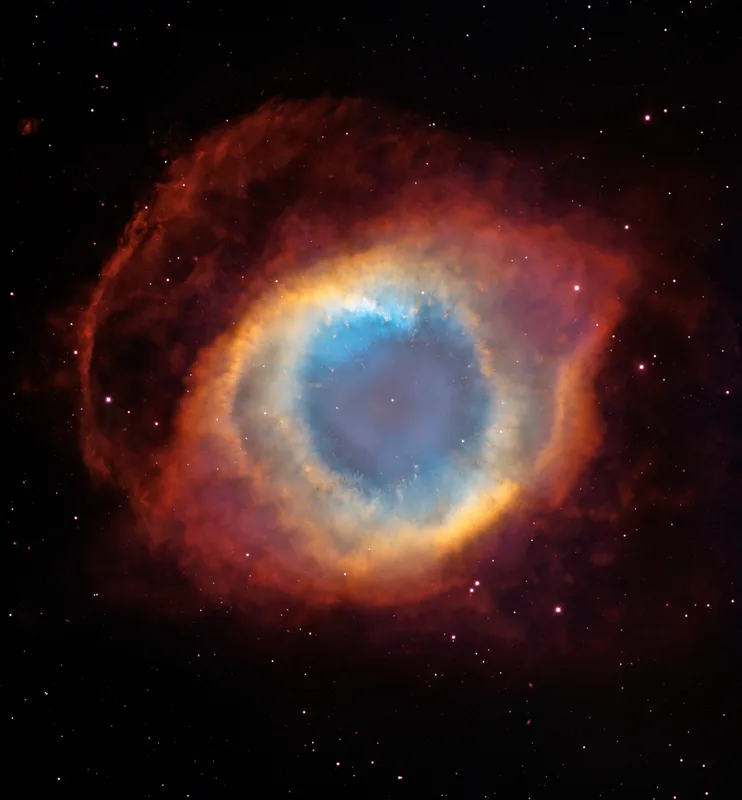
The Helix Nebula, NGC 7293 or Caldwell 63, is one of the nearest planetary nebulae to Earth, about 655 light-years away in Aquarius. Being so close, it appears huge, around 13 arcminutes across, close to half the width of the full Moon. Its total brightness of magnitude 7.3 is spread so thinly that it is easier to see in binoculars from a dark site than in a long-focus telescope at high power.
Observing tips
The nebula lies about 1.2° west of 5th-magnitude Upsilon Aquarii, roughly 10° northwest of Fomalhaut. Big binoculars show a round, gray glow, and a 100 mm scope at 25x to 40x reveals a faint disk with a slightly darker center. An OIII or UHC filter makes the biggest difference of any accessory here, bringing out the ring shape. With 200 mm or more and a filter, the ring looks uneven, brighter along two broad arcs. From 52°N it transits at about 17°, best in August and September, and rides much higher from the southern US and the Southern Hemisphere.
A small telescope under reasonably dark skies is a good starting point; use the live altitude chart to choose its highest point.
What to expect
The Helix is a shell of gas shed by a dying Sun-like star and lit by the hot white dwarf at its center. Its inner edge holds thousands of cometary knots, dense clumps of gas whose tails point away from the central star.
At about 13 arcminutes with a faint outer halo, it suits 500 to 800 mm focal length. Collect H-alpha and OIII data to separate the red outer ring from the blue-green center, and give the halo plenty of time.