Observer's guide
About Antennae Galaxies
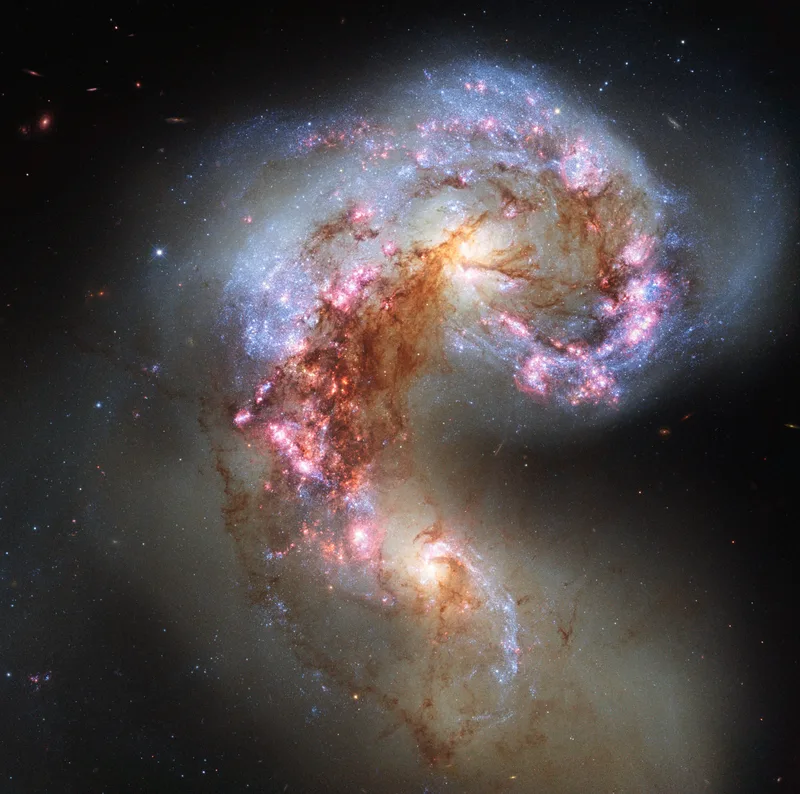
Caldwell 61 is NGC 4039, the southern member of the Antennae Galaxies in Corvus, locked in a collision with NGC 4038 (Caldwell 60) about 83 million light-years away. Smaller and slightly fainter than its partner at magnitude 10.4, it forms the southern end of the merging pair. The two are catalogued separately, but at the eyepiece you observe them as one system.
Observing tips
Use the same route as for NGC 4038: from Gienah in Corvus go about 3.5° west-southwest. NGC 4039 sits right against the southern edge of its companion, so a 100 mm scope shows only a single faint smudge. With 200 mm or more at 150x, look for the southern lobe that gives the combined glow its hooked or heart-like outline. Averted vision and a dark, transparent sky matter more than magnification here. From mid-northern latitudes it reaches about 19° at best, in March, while observers in the southern US and the Southern Hemisphere see it much higher.
Because it is faint, use a larger aperture where possible, avoid bright Moon conditions, and use averted vision.
What to expect
NGC 4039 is a spiral galaxy whose disk now overlaps with that of NGC 4038, and the region where they meet is rich in dust and newly formed star clusters. In time the two nuclei are expected to merge into a single galaxy.
Frame it together with NGC 4038 at 1000 to 1500 mm. Aim for enough signal to separate the dusty overlap region from the two bright nuclei, and process gently to keep the pink star-forming knots.